
New SKZ course: Product design and tool technology for injection molded parts
The economic success of a plastic product depends largely on the coordinated design of the article and the mold. With a new training course, the SKZ Plastics Center shows how article and mold design can be optimally coordinated from the outset to achieve higher component quality, stable processes, and maximum cost-effectiveness in injection molding production.
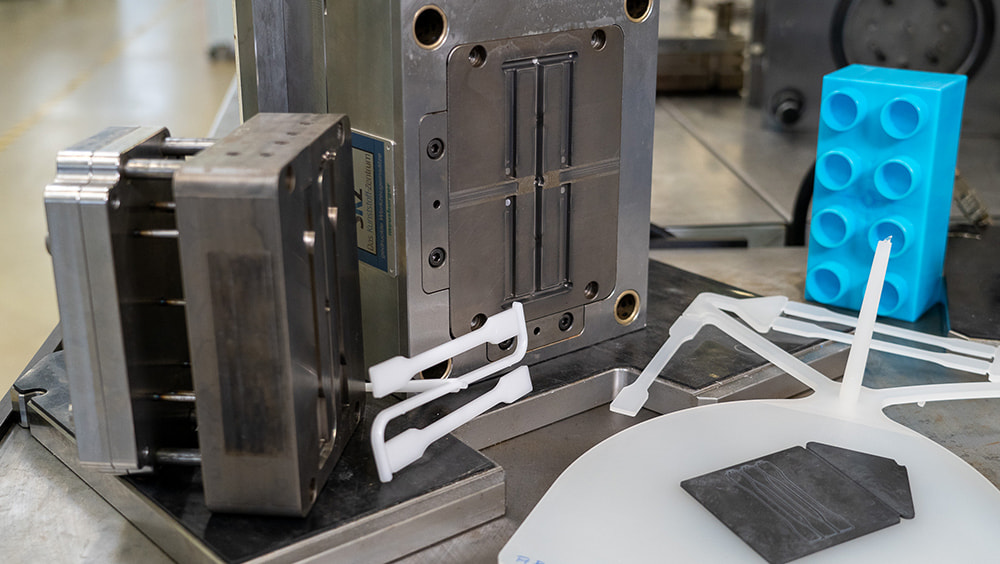
The new three-day course “Article Design and Tool Technology for Injection Molded Parts” will take place at SKZ headquarters in Würzburg and at the SKZ locations in Horb am Neckar, Halle (Saale), and Peine. (Photo: Luca Hoffmannbeck, SKZ)
New courses offered at SKZ locations
SKZ is expanding its continuing education program with a three-day, hands-on course on product design and tool technology for injection molded parts. The course covers key design guidelines for injection molded parts and their direct impact on tool design. The course is aimed at designers, process managers, and technical decision-makers who want to understand and optimize the entire development process—from component concept to production-ready injection molding tool.
The course focuses on the material properties and material characteristics of thermoplastics that are relevant to designers. Participants acquire in-depth knowledge of systematic material selection and learn how this affects component function, processability, and cost-effectiveness.
"The potential of well-thought-out component and tool design is often underestimated in practice. Yet this can lead to significant efficiency gains and cost savings,“ explains Robert Held, Group Leader for Injection Molding and Additive Manufacturing Training at SKZ. ”The increasing demands on optimal product and tool design prompted us to develop a new course that specifically combines both disciplines."
Product design: Function meets economy
Product design defines the functional, aesthetic, and technical properties of a plastic component. Material selection, wall thicknesses, flow path lengths, stiffness, and load scenarios are among the decisive parameters. Design errors often lead to quality defects, limited functionality, increased scrap, or, in extreme cases, product failure.
A central component of the course is the production-oriented design of injection molded parts. Fundamental design rules such as wall thicknesses, draft angles, the structural handling of undercuts, and suitable joining techniques in component development are covered.
Tool technology as a success factor
Tool technology is also crucial for manufacturing success. It influences not only the shape, but also process stability, component quality, and cost-effectiveness. The optimal gate positioning, the design of the mold temperature control system, compliance with required tolerances, and the target cycle time have a direct impact on manufacturing efficiency and mold costs. Precise coordination between the product and mold design is therefore a prerequisite for stable and cost-effective series production.
Participants learn about the basic functions of injection molding tools and gain an overview of different gating systems. Other topics include various temperature control concepts, the basics and special concepts of demolding, and the use of simulations for injection molded parts and tools in the development phase. The course is rounded off with topics such as recycling-friendly design, dimensional accuracy and tolerances, and laser marking of plastic components.
For optimal accessibility for participants, the classroom training takes place at the SKZ headquarters in Würzburg and at the SKZ locations in Horb am Neckar, Halle (Saale), and Peine.
Further information about the course