

DE | EN
Projects

Find projects

Back
Benefits
Members
Sponsors and Partner
Products
Test methods
Product certification
Inspection
Damage analysis
Conferences
Courses
Degrees
Online
In-house-training
SKZ Whitepaper
Material
Process
Metrology
Circular Economy
Digitalisation
Cooperation
Quality policy
Certification process
Downloads
Our Mission
Locations
Career
News
Back
Material

Polymer synthesis

Innovation for customized materials

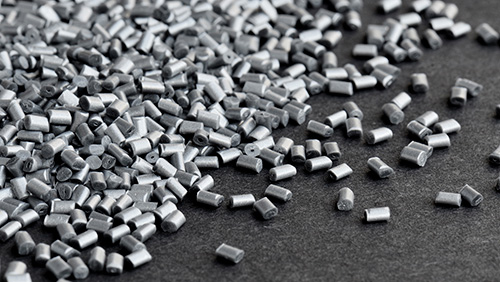
Polymer synthesis forms the basis for the development of modern plastics and opens up new possibilities for tailor-made material properties. Targeted chemical reactions produce polymers that enable new applications in a wide variety of areas.

Our expertise in the field of polymer synthesis:

  • Laboratory-scale synthesis and scale-up
  • Development of customized formulations
  • (Partially) bio-based systems
  • Use of synthesized resins for compounding on a laboratory and pilot plant scale

Thomas Zimmermann
Group Manager | Crosslinked Materials
Würzburg
t.zimmermann@skz.de

Services

Material selection

We offer market and literature research to identify suitable resin systems or promising modifications, taking your specific requirements into account. We focus particularly on biogenic raw materials.

Resin modification

We are happy to process synthesized resin (whether produced by us or by you). Among other things, we incorporate fillers, fibers, and additives using various mixing and dispersing units as well as compounding systems. In addition, we can produce batches ranging from grams to kilograms for our customers.

Synthesis of resin systems

The synthesis of thermosetting and special thermoplastic resins is becoming increasingly important for the development of new and adapted resin systems, e.g., for bio-based alternatives to established systems. In order to be a competent partner for industry in this field, SKZ is currently expanding this area of research. Several laboratory reactors are already available. We can optimize the synthesis conditions for resins in test series and make processes more efficient. Various raw material sources or building blocks can be examined in scientific test series to determine their suitability and their influence on polymer properties.

We are happy to carry out syntheses for you in the gram to double-digit kilogram range.

Characterization

Our focus is on characterizing the entire process chain—from monomers to (reactive) resin systems and compounds to the finished component. This includes: molar mass (GPC), reactivity and curing behavior (for thermosetting systems: DSC, DEA, rheometer), processability (rheometer), composition (GPC, FT-IR, SEM-EDX, incineration), dispersion quality (particle measurement technology), mechanical properties (tensile testing, hardness, impact strength, fatigue), thermal properties (DSC, DMA, TGA, HDT, Vicat), and aging behavior (climate change, constant climate, media storage, condensation test, UV irradiation, etc.).

Thermosets | Thermosetting plastics

Due to their excellent mechanical properties, high thermal and chemical resistance, and cost-effectiveness, thermosets are an attractive alternative to high-performance thermoplastics. They are produced by chemically cross-linking resin systems and are used as matrix materials in fiber composites, adhesives, casting compounds, and coatings, particularly in industries such as automotive, medical technology, and aerospace. At SKZ, resin systems are individually formulated and modified to meet the requirements of a wide range of applications.

To the section thermosets

Composites

The production of a wide variety of standard test specimens and special test specimens using casting, cutting, or injection molding processes is part of our numerous customer and R&D activities.

To the section composites

Cleaning and surface technology

Do you want to clean, pre-treat, or analyze the surface of your plastic components? SKZ supports you in selecting mechanical or physical surface pre-treatment processes based on technical and economic criteria.

To the section surface technology

Adhesive bonding

Many adhesives, such as epoxies, also belong to the class of thermosets. We offer adhesive modifications and tests related to modification (e.g., rheological properties). In addition, we provide support for bonding by personnel trained in accordance with DVS standards. From adhesive selection to feasibility studies, aging (climate change, constant climate, media influence, salt spray, condensation test, cataplasm, etc.) and load-dependent tests, we advise you on the entire process.

To the section adhesive bonding

Injection molding

For the subsequent investigation of the properties of new polymers, we produce test specimens for you on our injection molding machines. We produce corresponding (bonded seam) tensile bars, flow spirals, or universal mold plates according to your specifications and in accordance with current testing standards. We are also happy to carry out the corresponding tests on the test specimens to characterize the material properties. In addition, we also offer component and process simulations.

To the section injection molding

Non-destructive testing

The range of non-destructive testing methods is as diverse as the possible applications of polymers, including ultrasound, X-ray, terahertz and radar technology, and thermography. These methods can be used to detect defects such as pores and cavities in components or during manufacture in the liquid state. Similarly, the curing reaction can be monitored inline on the curing component in order to reduce cycle times and increase process reliability.

To the section Non-Destructive Testing

Knowledge

What does polymer synthesis actually mean?

Polymer synthesis refers to the chemical production of polymers—macromolecular substances consisting of many similar or different small building blocks, known as monomers. Through chemical reactions, these monomers combine to form long chains or cross-linked structures. In broad terms, polymer synthesis refers to the processes by which polymers are formed. Polymer synthesis is a central basis for the production of numerous plastics, resins, and elastomers and is used in areas such as packaging, medicine, electronics, and textile technology.
 

The most important polymer synthesis processes include:

  • Chain polymerization: Reaction in which monomers are gradually added to a growing polymer chain end through radical, ionic, or coordinative mechanisms

  • Step-growth polymerization: Formation of macromolecules through reactions between functional groups, often involving water elimination or other condensation reactions

  • Copolymerization: Joint polymerization of different monomers to produce customized material properties
Technical equipment

Analytics
  • Reactivity
    DSC, DEA analysis, rotational rheometer
  • Processability/flow behavior
    Rotational rheometer
  • Composition
    GPC, FT-IR, SEM-EDX, ashing (filler content)
  • Dispersion quality
    Particle measurement technology (DLS, SLS), computed tomography
  • Mechanical and fracture mechanical properties
    Universal testing machine (tensile, flexural, K1c tests), pendulum impact tester (impact strength), hardness testers, fatigue testing machine, creep testing equipment (temperature, media)
  • Thermal properties
    DSC, DMA, TGA analysis, heat deflection temperature (HDT), Vicat softening temperature
  • Aging behavior
    Climate change, constant climate, media storage, condensation test, UV irradiation
  • Inline quality assurance procedures
    e.g., inline thermography: temperature distribution on the component surface immediately after demolding
Synthesis

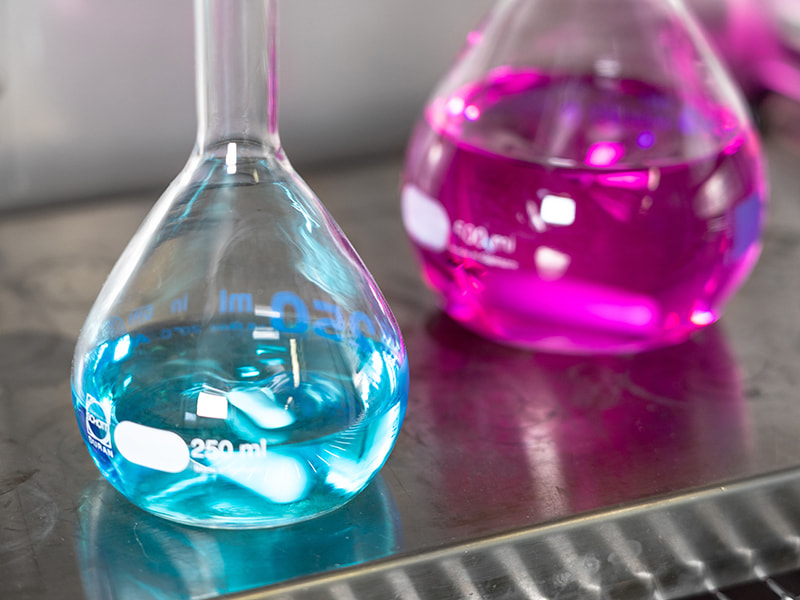
Several glass flasks including heating hoods, stirrer, protective gas supply, vacuum, and optional distillation apparatus

Dispersion process

Dissolver, rotor-stator disperser, three-roll mill, high-pressure homogenizer, ultrasonic homogenizer, universal mixer, intensive mixer, dual-asymmetric centrifuge, agitator ball mill

Compounding plants

In our technical center, formulations can be prepared and refined, and sample materials for test specimens or prototypes can be produced. Several twin-screw extruders and special extruders (planetary roller extruders, ring extruders, co-kneaders) are available for this purpose. We also have access to a laboratory kneader (“MetaStation”) and a rolling mill.

Processing machines

The following processes are available for processing into hardened molded parts: injection molding (free-flowing molding compounds and BMC), autoclave, vacuum infusion, resin transfer molding (RTM and RTM Light), hand lamination, hot and wet pressing. Squeegee systems, mixers, and various manual application systems for cartridges and different mixing ratios are available for bonding.

We offer the following processes for the application of coatings: powder coating system, automatic paint booth, squeegee system, inkjet printer.

Your message to us

We need your data to be able to respond to your request by e-mail. You can find more details in our privacy policy.

Ihr Browser ist veraltet

Für das beste Nutzererlebnis auf unserer Webseite empfehlen wir die Verwendung eines aktuellen Webbrowsers. Bitte aktualisieren Sie Ihren Browser, um alle Funktionen störungsfrei verwenden zu können.