

Search standard for testing available at SKZ

Testing of uPVC window
and door profiles
Testing of uPVC window
and door profiles
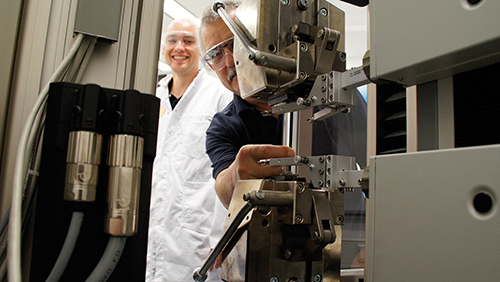
In our accredited test laboratory we test
and certify uPVC window profiles
The use of uPVC profiles for windows and front doors offers a number of advantages compared to other materials such as wood or aluminum. Thanks to their chamber system, uPVC profiles have excellent thermal insulation properties. They help to minimize heat loss and thus contribute to improved energy efficiency in buildings. uPVC window and door profiles are extremely durable and have excellent weather resistance. uPVC profiles are largely resistant to environmental influences such as moisture, wind, rain and sunlight. They do not rot or rust and are less susceptible to deformation compared to wood or metal. uPVC windows and doors generally require little maintenance and are therefore particularly low-maintenance. They are easy to clean and retain their aesthetic properties over long periods of time. uPVC window profiles and door profiles offer a wide range of design possibilities and can be produced in different colors. They can meet the architectural requirements and personal taste of the customer. uPVC window profile systems contribute to increased sound insulation by reducing numerous external noises, resulting in an improved quality of living. Compared to other materials, uPVC profiles are often less expensive to manufacture and install. This makes them an economical option for builders and renovation projects. Modern uPVC profiles are increasingly made from recyclable material and are therefore environmentally friendly and resource-saving. The recyclability helps to reduce the ecological footprint. uPVC windows are lighter than windows made from other materials, which makes installation easier and minimizes structural loads. uPVC windows and doors can be fitted with advanced security features to increase protection against break-ins. Increasingly, window and door systems are being integrated into smart building control systems, for example to save heating energy through intelligent ventilation controls or to prevent weather damage during absences.



Our committee work
- RAL expert group "Profiles"
- DIN NA Plastics 054-04-07 AA
"Plastic profiles for windows and doors (GKFP-UA 1)" - CEN/TC 249/WG 05 "Thermoplastic profiles
for building applications" - CEN/TC 249/WG 21 "Profiles for windows and doors"
Our services for testing
of plastic window profiles
All measures for operational quality assurance in the production of plastic window and door profiles, laminating films, adhesive systems for lamination, lacquer coating systems and extruded sealing profiles.
- External monitoring
- System of factory production control (FPC)
- Suitability tests and extensions of approvals
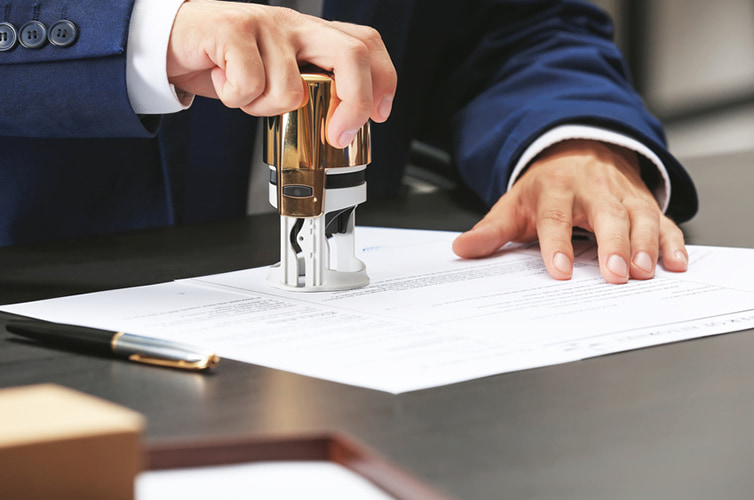
- Preparation of monitoring reports, test certificates and certificates
- Damage assessment and preparation of expert reports
We carry out numerous tests on plastic window profiles on the basis of international test standards.
- Testing of material-specific properties of window and door profile formulations in accordance with RAL-GZ 716, DIN EN 12608-1 and other international standards
- Testing of profile-specific properties of window and door profile formulations in accordance with RAL-GZ 716, DIN EN 12608-1 and other international standards
- Testing of weather resistance and long-term behavior in accordance with RAL-GZ 716, DIN EN 12608-1, DIN EN 513, DIN EN ISO 4892-2 and other international standards
We test the following products
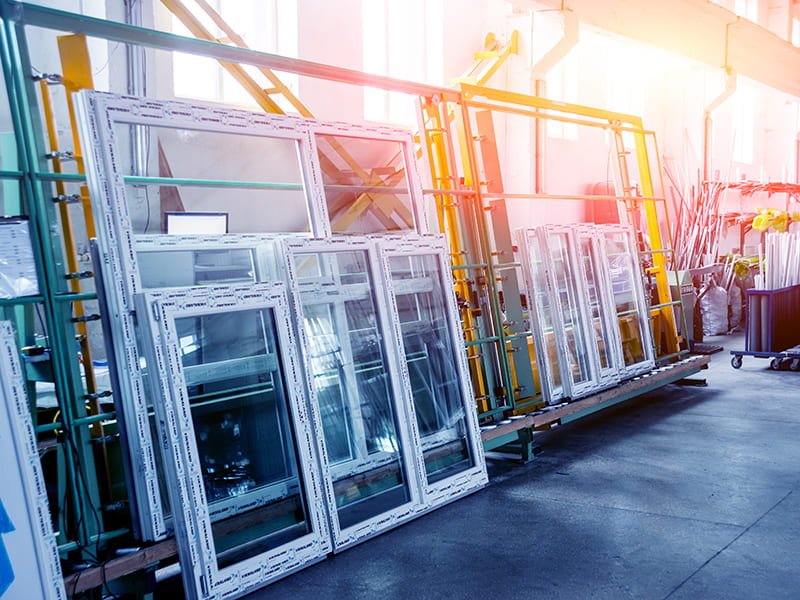
uPVC plastic profiles (with light-colored surfaces)
uPVC plastic profiles are construction elements made from unplasticized polyvinyl chloride (uPVC). uPVC is a special form of polyvinyl chloride (PVC), also known as rigid PVC, in which no plasticizers are added.
Film-laminated plastic profiles
Film-laminated uPVC window profiles are uPVC profiles for windows and doors that are covered with a thin film. This film is usually made of a decorative material that is available in various colors and designs. The lamination not only serves aesthetic purposes, but also provides additional protection in terms of weather resistance for the uPVC profile.
Color-coated plastic profiles
Color-coated uPVC window profiles are uPVC profiles that are given a specific color through a special color coating. This coating is applied to the uPVC material not only to create an aesthetically pleasing surface, but also to provide additional protection and functionality.
Coextruded plastic profiles with acrylate coatings (PMMA)
Coextruded uPVC window profiles with acrylic coatings are special types of window profiles that are manufactured using the coextrusion process. Coextrusion is a process in which several layers of different materials are pressed through an extrusion die at the same time. This enables the formation of multi-layer profiles with different properties.
Fiber-reinforced plastic window profiles
Fiber-reinforced plastic window profiles are window frames that are reinforced by adding fiber materials to a plastic matrix material. These profiles are usually glass fiber reinforced and there are stiffening semi-finished products made of PBT (polybutylene terephthalate) inside the profiles, which thus replace the steel or steel reinforcement.