
Training for tomorrow's additive manufacturing
With its “Certified Setter – Additive Manufacturing” course, the SKZ Plastics Center offers practical training for plastics processing specialists. The course provides a sound, application-oriented understanding of the entire additive process chain, from materials and processes to safety and quality assurance to cost-effectiveness.
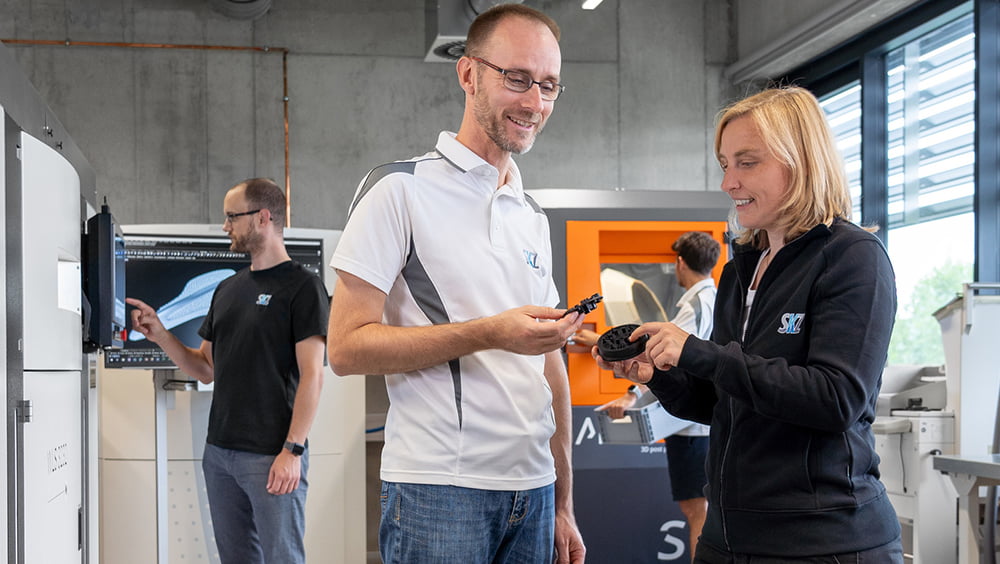
The practical training course to become a “Certified Setter – Additive Manufacturing” takes place in spring and fall at SKZ in Würzburg. (Photo: Luca Hoffmannbeck, SKZ)
SKZ offers practical training course for plastics processing specialists
Additive manufacturing processes have long been established in numerous sectors of the plastics industry, including aerospace, automotive, electronics, medical technology, and construction. Compared to conventional manufacturing processes, additive technologies use less material and thus make an important contribution to resource-efficient and sustainable production. In view of technological advances and increasing demands, a further expansion of the range of industrial applications is expected.
The practical course is aimed at setters, technicians, master craftsmen, and skilled workers from production and manufacturing who want to use additive manufacturing efficiently and safely. During the five-day training course to become a “Certified Setter – Additive Manufacturing,” participants acquire in-depth knowledge of plastics science and a thorough understanding of the advantages and disadvantages of additive manufacturing processes. Extrusion-based, powder bed-based, and resin-based processes are covered. A comprehensive insight into these technologies is supplemented and deepened by hands-on practical training directly on the equipment. The aim is to understand the specific characteristics of the processes, to master the basic process steps, and to be able to evaluate the processes in terms of their limits of application, economic efficiency, and component requirements.
In addition to machine operation, the focus is on understanding process relationships, material behavior, and quality criteria, as well as process-specific properties, typical areas of application, and the respective strengths and limitations of the technologies. A central element of the course is targeted preparation for the job profile of a setup engineer in additive manufacturing, from process preparation and equipment operation to process monitoring.
“We specifically train specialists for the safe, quality-oriented, and economical use of additive manufacturing processes in industrial practice,” says Irena Heuzeroth, senior trainer at SKZ in Würzburg. “This closes an important gap between technology, application, and the increasing demands of additive plastics processing.”
In addition to process knowledge, the course also covers safety-related aspects of additive manufacturing. The proper handling of powders and resins as well as basic occupational safety measures are an integral part of the course.
In addition, participants acquire in-depth knowledge of the professional slicing of additively manufactured components and the systematic identification of typical process- and material-specific error patterns. They learn to analyze their causes and derive appropriate countermeasures. In addition, basic design guidelines for additively manufactured plastic components are taught.
The economic potential of additive manufacturing is also specifically highlighted. In addition to the fast and flexible production of prototypes, the focus is particularly on industrial benefits: Additively manufactured mounts, fixtures, grippers, and aids enable short response times and a high degree of customization, and can often replace cost-intensive metal or aluminum fixtures in series production. As a result, they make a significant contribution to productivity, process stability, and quality in manufacturing.
Another focus is on quality assurance. Participants carry out tensile and impact tests and learn about material- and process-specific analysis methods for evaluating additively manufactured components. Post-processing, from mechanical finishing and coloring to surface treatment, is also taught in a practical manner with the aim of ensuring reproducible, high-quality components that meet industry standards.
The course is characterized by a high practical component of 50%. In the SKZ technical center, participants work on industrially used 3D printers and apply their acquired knowledge directly.
The next course will take place from March 2 to 6, 2026, and from October 19 to 23, 2026, at the SKZ in Würzburg.