
SKZ Expands Its Portfolio in Digitalisation for the Plastics Processing Industry
The SKZ Plastics Center is expanding its offerings in the field of digitalisation and currently offers four new courses ranging from the use of digital technologies to the development of custom applications. In addition, the institute supports companies with process analyses, AI-powered systems, and customized software solutions across the entire value chain.
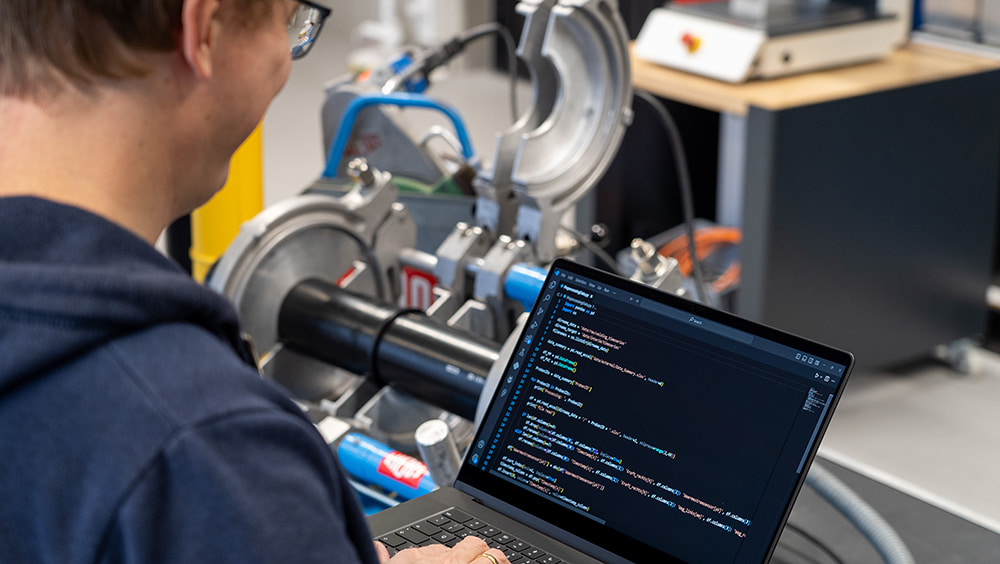
The SKZ Plastics Center offers comprehensive digital expertise specifically tailored to the plastics industry. (Photo: Luca Hoffmannbeck, SKZ)
New courses, hands-on training, and solutions ranging from AI to software development are now available
Products and their associated data are increasingly interconnected. For many companies in the plastics industry, this gives rise to complex technical and organizational challenges. Especially in globally networked supply chains, digitalisation is proving to be a key approach to improving efficiency.
The SKZ offers a wide range of support for this—from AI-powered applications and smart measurement systems to custom-developed software solutions. “Thanks to our in-depth understanding of processes, we can identify companies’ individual needs and develop suitable solutions,” says Christoph Kugler, Head of the Digitalisation Group at the SKZ. “Our services range from consulting and training to practical research-based approaches that can be applied to real-world processes.”
In digitalization projects, the institute analyzes existing manufacturing processes, identifies optimization potential, and supports their implementation. The goal is to create transparency, increase efficiency, and improve product quality. Data analysis enables informed decisions, while AI systems provide support, particularly in process monitoring and the handling of repetitive tasks. Responsibility remains deliberately with the specialist staff, who are relieved of some workload by digital tools.
Custom Software Solutions for Specific Requirements
For issues where no standard solutions are available, the SKZ develops its own software tools and apps. Open-source-based approaches are frequently used, which can be utilized independently of individual vendors.
Practical examples include applications for optimizing die design in extrusion, for spatially resolved velocity measurement of extrudates, or for temperature-based process monitoring without invasive measurement technology. Solutions for monitoring injection molding processes and for integrating AI models via low-code platforms have also already been implemented.
Training Programs on Digitalization
With these four new courses, the SKZ provides practical knowledge on digital technologies in plastics processing—from the basics to programming custom applications. The focus is always on plastics processing and the data generated in this context. Participants can apply the content directly in their daily work.
Further Information on the Digitalisation Research Area