

AI Stabilizes Recycled Material Processing in Injection Molding
The processing of post-consumer recycled materials (PCR) continues to pose significant technical challenges for the plastics industry. In particular, rising recycled content levels lead to increased material variability, resulting in unstable injection molding processes and higher scrap rates. In the Rezi-KI research project, the SKZ Plastics Center and AI specialist plus10 are developing a data-driven solution to automatically stabilize such process fluctuations.
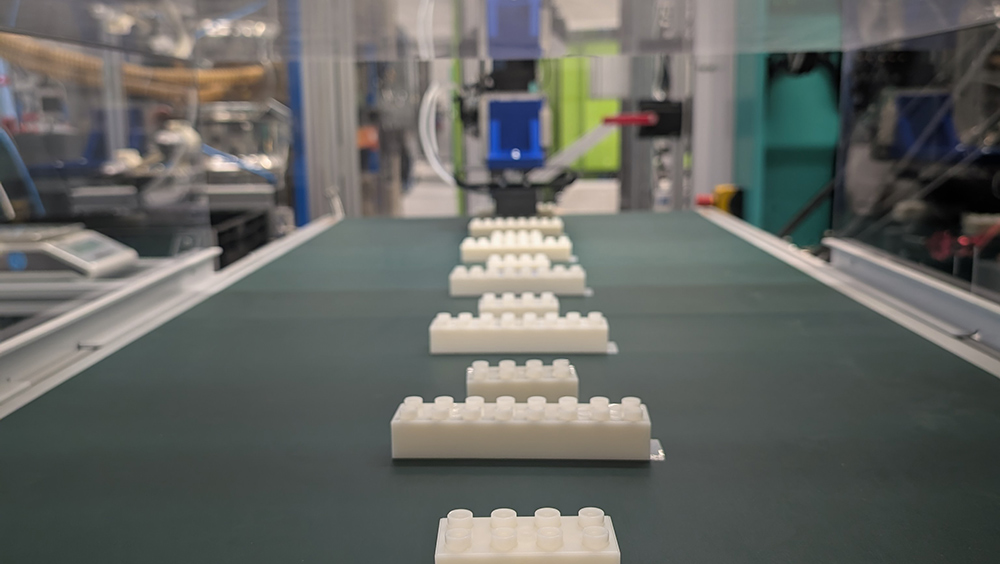
Clamp modules with flow indicators for developing AI-based control systems when using post-consumer recycled materials in the Rezi-KI project. (Photo: Jakob Schüder, SKZ)
SKZ and plus10 Develop Intelligent Solution for Processing Post-Consumer Recyclates
The goal of Rezi-AI is to use process engineering to bring the processing of PCR materials to a level of stability comparable to that of virgin material. To achieve this, AI-based predictive models are used to calculate the probability of scrap in real time based on process and material data. Based on this, dynamic recommendations for adjusting process parameters are generated.
This is intended to stabilize part quality, optimize cycle times, and reduce energy consumption. At the same time, the approach helps make the industrial use of recycled materials more economically robust and reduce the carbon footprint in plastics processing.
Fully Networked Injection Molding Cell as a Data Source
To implement this, a fully networked injection molding cell was set up at SKZ, where all process-relevant data is recorded and consolidated with cycle-by-cycle precision. This includes both machine data and information from the hot runner, mold, and temperature control systems, as well as quality characteristics such as demolding temperature and part weight.
In addition, the energy consumption of individual major consumers is recorded to enable a comprehensive data-driven evaluation of the entire process. Data communication is based on the end-to-end integration of OPC UA and MQTT, enabling direct feedback between process parameters and part quality.
Mold technology and cavity-specific control
In collaboration with the mold maker GHD Präzisionsformenbau, a special 2-cavity clamping block mold was developed that is specifically designed for investigating material variations. An integrated flow indicator enables a differentiated analysis of filling behavior.
The EWIKON hot runner system used is equipped with a servo-electric needle valve controlled via the motion CONTROL system. As part of the project, this needle valve was additionally opened for external software-based control.
This makes it possible to specifically compensate for material and filling variations not only via traditional machine parameters but also on a cavity-by-cavity basis via the needle stroke of the hot runner system.
Integration of Material Data and Digital Infrastructures
Another focus of the project is the integration of material data. Since recycled material batches are naturally subject to greater fluctuations, batch-specific measurement values are integrated directly into the AI models. In the future, it is planned to make this data available directly from material suppliers via API-based interfaces.
This approach is supported by emerging industrial data spaces, such as those being developed in the context of Manufacturing-X and initiatives like MaterialDigital.
First demonstration at SKZ Technology Day
Project Manager Jakob Schüder emphasizes the significance of the initiative: “Rezi-AI demonstrates how artificial intelligence can play a key role in sustainable plastics processing. Our goal is to make the processing of post-consumer recyclates just as stable and efficient as that of virgin material, despite sometimes significant material fluctuations. We would like to extend special thanks to our project partner plus10, whose AI and software expertise significantly supports this innovative approach.”
The ongoing test series are currently being used to validate the developed AI models.
Initial results of the AI-supported process control are to be demonstrated using the clamping block mold at the SKZ Technology Day on June 25, 2026, in Würzburg.
The project is funded under the BayVFP program.
Further information on the Injection Molding Research Division