

Computed tomography at SKZ: non-destructive insights into granulates and plastic components
Computed tomography (CT) is a non-destructive testing method that provides detailed insights into the interior of a wide variety of materials and components. At the SKZ Plastics Center, CT analyses cover a wide range of applications: from the examination of fiber-filled and foamed components to the detection of internal defects and the quantitative recording of geometric features and local density profiles.
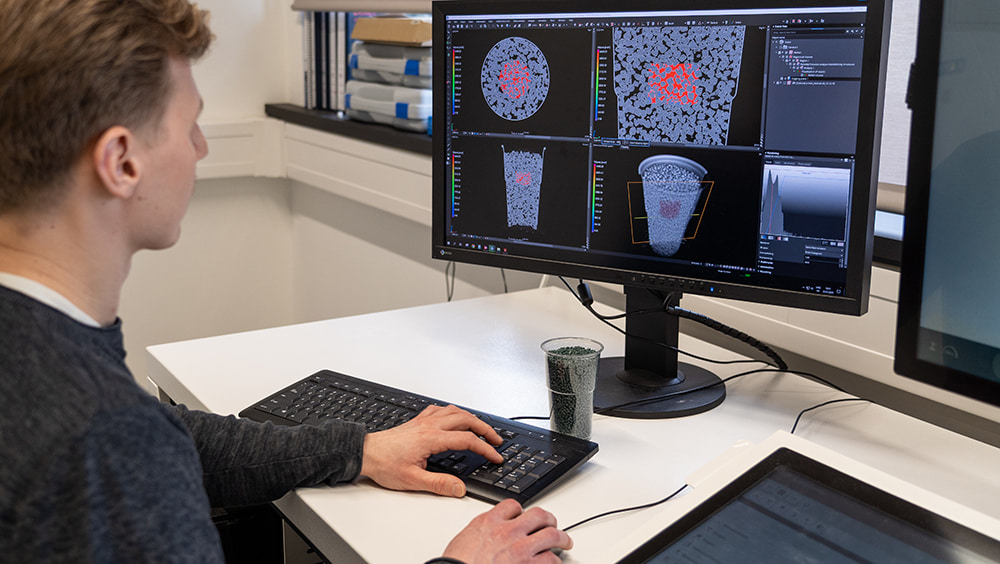
CT analysis of plastic granulate to detect air pockets and foreign matter. (Photo: Luca Hoffmannbeck, SKZ)
Würzburg Institute offers three-day practical training course
Computed tomography (CT) can be used to obtain high-resolution insights into the interior of components without damaging them. A volume data set is first reconstructed from a large number of X-ray projections taken during the rotation of the test object. A precise 3D model can then be derived from this. This direct imaging measurement technology provides comprehensive insights into material distributions, geometries, and potential structural abnormalities, thus making an important contribution to identifying process errors and improving quality assurance.
CT is also an efficient method for examining plastic granules. Air pockets or foreign particles can be detected and quantitatively evaluated in terms of their location, size, and frequency. This allows the quality of the material to be assessed objectively and at an early stage, even before it is processed in extrusion or injection molding processes.
“Computer tomography is proving to be an efficient instrument for non-destructive testing, particularly due to the increasing use of recycled materials,” explains Daniel Seewald, scientist in the Non-Destructive Testing group at SKZ in Würzburg. “The findings obtained from this can make a decisive contribution to preventing the introduction of foreign particles or inferior granulate.”
Thanks to their high resolution, CT scans are also suitable for detecting cavities, cracks, or contaminants, as well as for examining fiber orientations and porosities in extruded or injection-molded components. In particular, the often pronounced differences in density between plastics and foreign materials produce clear image contrasts, which usually make defects easily recognizable. Foam structures can also be characterized in detail. This makes it possible to draw valuable conclusions about process parameters and their influence on the properties of the resulting components.
The CT scanners used at SKZ deliver high contrast, can capture even large sample volumes, and enable resolutions down to the single-digit micrometer range. The SKZ thus offers companies comprehensive support in all matters relating to material and component analysis.
In addition, the SKZ offers a three-day course that provides a practical introduction to X-ray technology with a focus on CT applications in the plastics industry. The focus is on practical measurements and evaluations as well as theoretical basics. The potential and limitations of the technology are also explained. After completing the course, participants will be able to perform CT measurements independently and interpret the collected data professionally.
More information and registration for the course
More information on non-destructive testing