
AutoROCK digitizes extrusion: AI will detect errors in real time in the future
The SKZ Plastics Center and the Fraunhofer Institute for Integrated Circuits IIS are driving forward the digitization and automation of extrusion in their joint research project AutoROCK. The aim of the project is to enable the automated, reliable detection of defects in plastic profiles directly during production. AutoROCK thus addresses a key challenge in plastics processing: identifying quality deviations at an early stage before they lead to rejects, material loss, or costly rework.
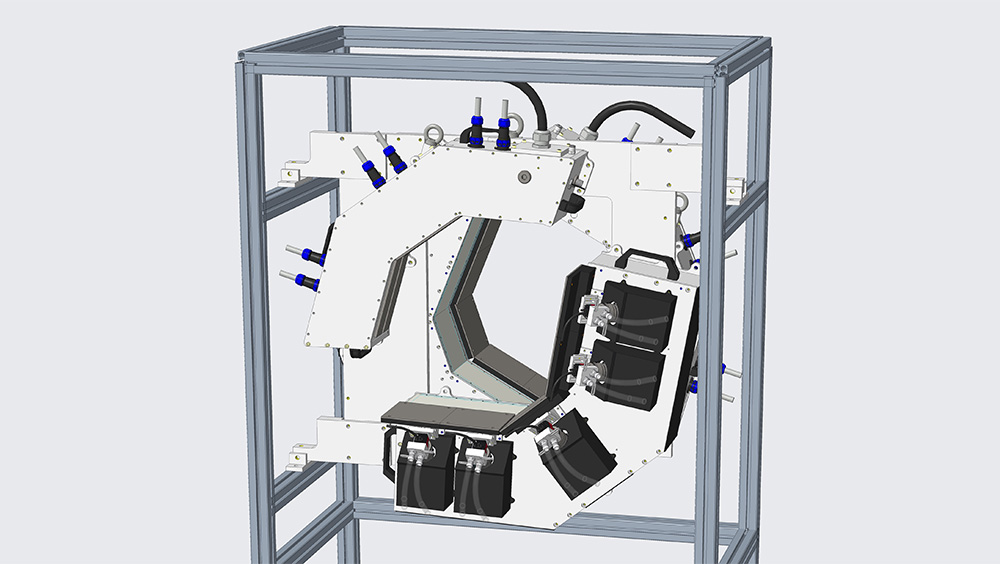
CAD model of the pure online X-ray CT measurement system without cladding and X-ray protection device. (Photo: Fraunhofer IIS)
SKZ and Fraunhofer IIS develop AI-supported CT technology for automated defect detection in profile extrusion
In order to create a reliable database for the development of an AI-supported monitoring system, extrudates with characteristic defects have been specifically produced in the project to date. In addition, manufacturing companies have provided rejected products with typical defects. The defects present, including cavities, foreign material inclusions, pores, and geometric errors, make it possible to map reproducible and realistic scenarios.
The samples were then examined using state-of-the-art X-ray CT systems and established non-destructive testing (NDT) methods. The resulting data set now forms the basis for training an AI system that will be able to automatically detect, classify, and evaluate defects in terms of their relevance. Thanks to the diversity of the data collected, the AI learns to identify even complex or overlapping defect structures.
At the same time, the project developed a concept for a specially adapted demonstrator that will enable online measurements during extrusion in the future. The requirements for such a system are high: it must guarantee robust measurements despite continuous material movement, high throughput speeds, and limited installation space, as well as ensuring radiation protection. In addition, the technology must be designed in such a way that it can be seamlessly integrated into existing production lines without impairing the process flow. The developed concept takes these challenges into account and creates a basis for a new generation of inline-capable CT systems. Practical tests will take place in the course of the year.
The combination of AI and adapted CT technology opens up new possibilities for the plastics industry. Real-time monitoring will enable quality deviations to be detected immediately and process parameters to be adjusted dynamically in the future. This is expected to result in a significant reduction in scrap, greater process stability, and improved resource efficiency. At the same time, continuous data collection enables comprehensive documentation of product quality.
Interested companies are invited to contact the project partners for further information.
The project (funding code 01IF23187N) is funded by the German Federal Ministry for Economic Affairs and Energy (BMWE) as part of the program for promoting industrial joint research (IGF) via the German Aerospace Center (DLR).
Further information on non-destructive testing