
Trust Through Proven Quality – Why Accreditation Is Crucial for Manufacturers
World Accreditation Day is celebrated worldwide on June 9. To mark the occasion, the SKZ Plastics Center is highlighting the importance of independent conformity assessment bodies. Accredited testing, inspection, and certification bodies play a key role in ensuring the quality and safety of products, services, and processes in a transparent and traceable manner.
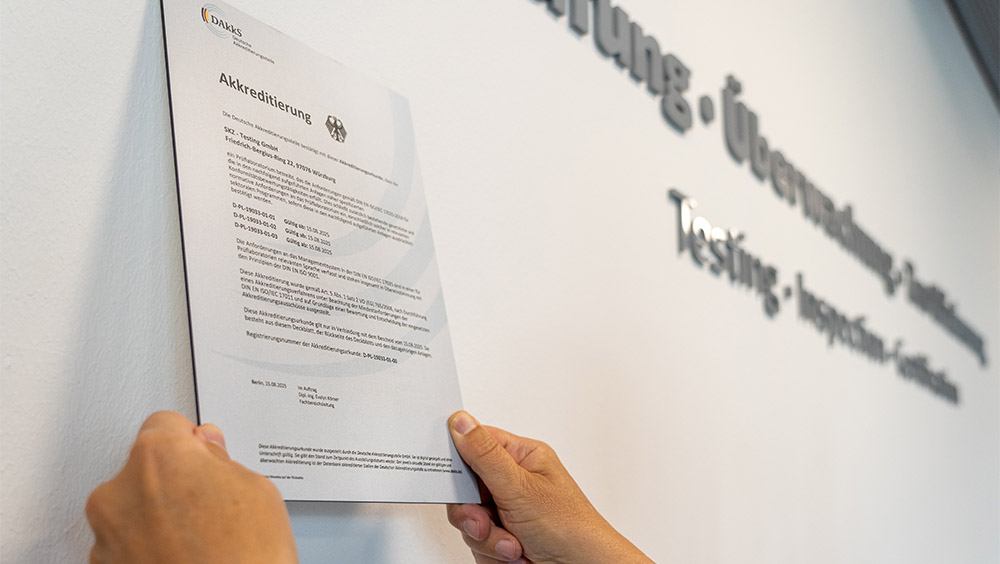
To mark International Accreditation Day on June 9, the SKZ is highlighting the importance of independent conformity assessment bodies. (Photo: Luca Hoffmannbeck, SKZ)
SKZ Highlights the Role of Independent Conformity Assessment
Accreditation signifies proven technical competence, independence, and traceable test results. Tests conducted by accredited bodies are based on internationally recognized standards and enable an objective assessment of technical properties. The results are comparable both nationally and internationally and serve as a reliable basis for evaluations and decisions by authorities, institutions, and companies.
Accredited Plastics Testing
As an accredited testing service provider, SKZ offers a wide range of services in plastics testing. These include mechanical, thermal, and chemical tests, as well as long-term testing and the development of requirement-specific testing concepts. The tests support, in particular, the verification of technical requirements and compliance with regulatory standards.
“Accredited testing is far more than just formal proof—it is a decisive competitive advantage,” explains Katja Müller, Head of the Certification Body. “Manufacturers benefit from reliable test results, reduce risks, and increase market acceptance of their products.”
Legal certainty, market access, and risk minimization
Collaboration with an accredited testing body offers several advantages. Standard-compliant and recognized testing procedures increase legal certainty. Internationally accepted test certificates facilitate access to regulated markets. Furthermore, systematic testing enables the early identification of technical weaknesses and contributes to risk minimization. Documented compliance with relevant requirements also strengthens the traceability and credibility of technical claims.
Accreditation in an Economic Context
“Fortunately, the importance of an efficient and effective accreditation system as a competitive factor for the economy is also increasingly coming into focus in politics and government ministries,” emphasizes Managing Director Dr. Thomas Hochrein. At the same time, he sees a need for reform: “From the perspective of many associations, industry representatives, and testing institutes, the accreditation system in Germany requires significant further development, as numerous position papers demonstrate.”
Especially against the backdrop of increasing regulation and international supply chains, the role of independent testing continues to gain importance. Accredited bodies make a significant contribution to transparency, comparability, and technical safety.
Further information on product certification