
SKZ to Showcase Plastics Innovations at the 2026 SME Innovation Day in Berlin
At the invitation of the Federal Ministry for Economic Affairs and Energy (BMWE), the SKZ Plastics Center presented its work on June 11, 2026, at the BMWE’s Innovation Day for Small and Medium-Sized Enterprises in Berlin. Under the theme “Innovative. Strong. SMEs,” the SKZ used three research projects to demonstrate how plastics research can provide practical solutions to industrial challenges.
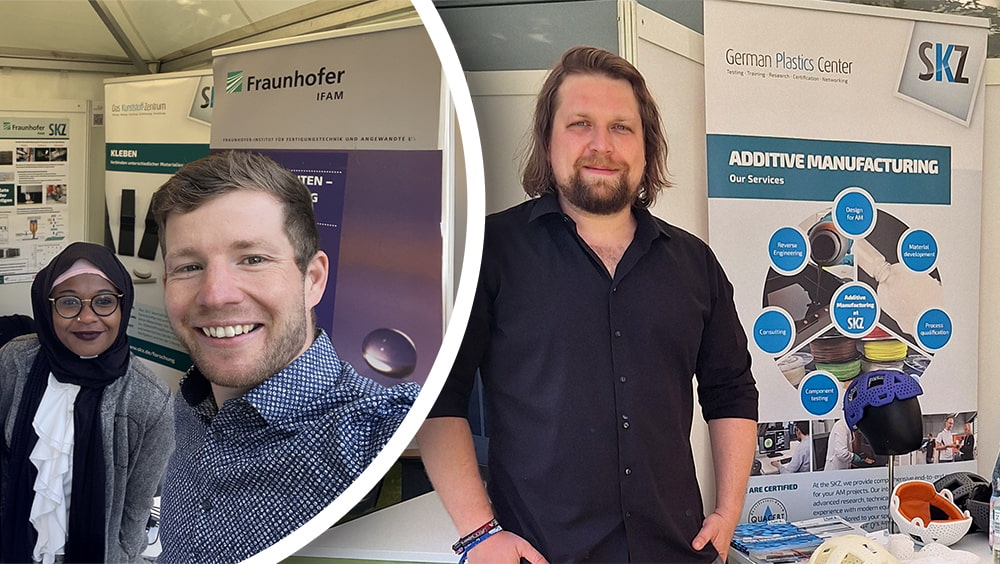
The SKZ team at the BMWE’s 2026 SME Innovation Day in Berlin on June 11, 2026: Halimatu Sadiya Bruce, David Herbig, and Eugen Schleiger (from left). (Photo: SKZ)
Practical Solutions for the Circular Economy, Processing Technology, and Medical Technology
The event brought together around 300 exhibitors from various industries and demonstrated how funded research leads to concrete, practical solutions. SKZ staff members David Herbig, Halimatu Sadiya Bruce, and Eugen Schleiger covered a broad spectrum of current issues in plastics technology, ranging from the improved use of recycled materials to new processing methods and customized medical protection solutions:
Reliably bonding and coating recycled materials (IGF 22619 N)
Together with Fraunhofer IFAM, the SKZ investigated how recycled plastics can be specifically pretreated for subsequent bonding and coating processes. The results showed that customized atmospheric-pressure plasma processes can help compensate for fluctuating material qualities and varying surface conditions, making recycled materials more reliably usable in existing applications.
Continuous Compounding Process for Solid Silicone (IGF 23175 N)
Another project focused on the development of continuous compounding processes for solid silicone rubbers. The goal was to process solid silicone more efficiently, with greater reproducibility, and with higher process reliability. In this context, new approaches were developed to tailor material properties more precisely and to enable the industrial processing of high-performance elastomer materials in a more efficient and cost-effective manner.
Customized Medical Head Protection via 3D Printing (ZIM KK5068031)
As its third project, the SKZ presented a ZIM collaboration project on the additive manufacturing of customized medical head protection. Together with ATO FORM GmbH, protective solutions were developed that can be individually customized based on head scans and manufactured using 3D printing. This approach combines additive manufacturing, digital scanning, and medical technology applications. As a result, protective products can be developed that are better tailored to the individual needs of users.
Exchange with Small and Medium-Sized Enterprises, Research, and Policy Makers
The Innovation Day for Small and Medium-Sized Enterprises once again offered the SKZ the opportunity to present research findings to a broad public and engage in dialogue with representatives from business, science, and politics. Particularly valuable was the direct exchange with companies facing similar technological challenges and seeking practical solutions for their production, materials, or new applications.
“Innovation Day clearly demonstrates what applied research can achieve when it is developed in close alignment with the needs of small and medium-sized enterprises. Our projects make it clear that plastics technology is a key driver for the circular economy, industrial process innovation, and new applications,” says Dr. Frédéric Achereiner, Project Manager for Research and Innovation at SKZ. “For us, this direct on-site exchange is particularly valuable because it turns research findings into concrete discussions, new contacts, and often new ideas as well.”
Innovation You Can Touch
The SKZ projects impressively demonstrated how funded research gives rise to marketable solutions and tangible added value for industry and society. In doing so, the SKZ underscores its role as a practice-oriented research partner for small and medium-sized enterprises and as a bridge between scientific development and industrial application. As an institute of the Zuse Association and one of Europe’s leading plastics research institutes, it helps shape this innovation.
About the Projects
The projects presented were funded by the Federal Ministry for Economic Affairs and Energy as part of the Joint Industrial Research (IGF) program and the Central Innovation Program for SMEs (ZIM), based on a resolution of the German Bundestag.