

“We bridge the gap between regulatory review and real-world application”
How can the service life and reliability of plastic products be reliably predicted without waiting decades for real-world experience? The High-Pressure Autoclave Test (HPAT) provides valuable insights in this area. In this interview, Anja Armani, Senior Project Manager for Construction Products at SKZ, explains how the accelerated testing method works, what added value it offers compared to traditional standard tests—and why it is becoming increasingly important for manufacturers and developers.
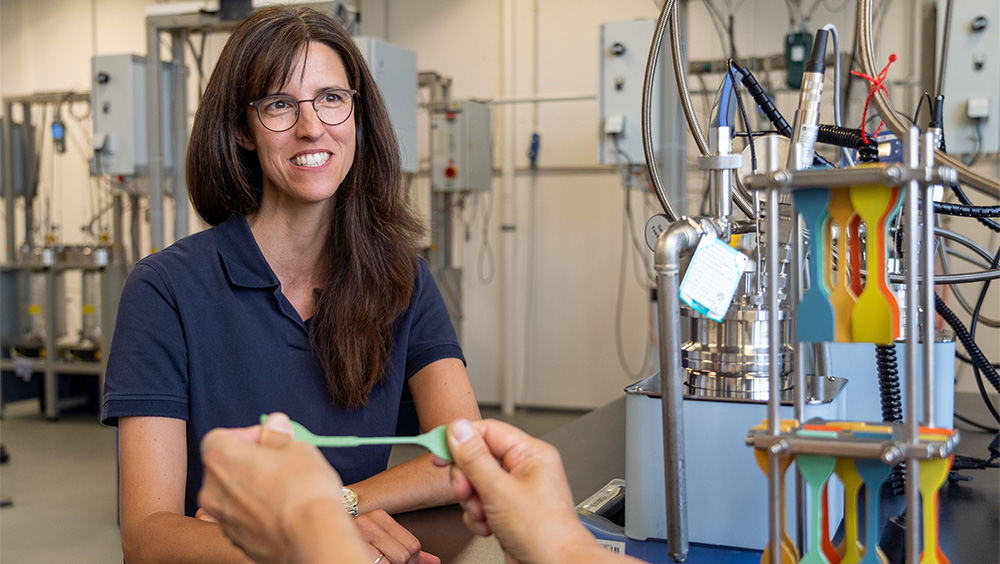
In this interview, Anja Armani provides insights into the function of the high-pressure autoclave test (HPAT). (Photo: Luca Hoffmannbeck, SKZ)
Focus on HPAT: How accelerated testing methods provide reliable insights into the service life of building products
SKZ: Anja, the high-pressure autoclave test—HPAT for short—sounds very technical at first. Can you explain in simple terms what this test is used for?
Anja Armani: Certainly. The HPAT is an accelerated testing method we use to investigate the thermo-oxidative aging of plastic materials and products and to predict their service life. Put simply: We expose the product to extreme conditions such as elevated oxygen pressure, temperature, and an aqueous medium to determine in a short period of time how it would behave over many years in real-world use.
SKZ: So, in principle, does the test replace years of practical experience?
Armani: Of course, nothing can replace years of practical experience. Like all other accelerated aging methods, the HPAT is merely a simulation. However, it is highly informative. And waiting it out won’t get us there—it takes too long. Especially in construction or with piping systems, you can’t simply wait 20, 50, or even 100 years to assess durability. The HPAT greatly accelerates aging processes. This way, manufacturers and users receive reliable information about the service life and reliability of their products within weeks.
SKZ: In your view, what is the particular added value of the HPAT as a testing method compared to established aging and standard tests?
Armani: The key added value of the HPAT lies in its methodological flexibility and informative value. Many standard tests are limited to strictly defined scenarios and service lives. However, customers often come to us with questions about service life under specific operating conditions that go beyond the scope of standards. With good reproducibility, the HPAT allows for the targeted simulation of such application conditions as elevated temperatures, different media, or varying pH values.
Furthermore, the HPAT not only provides evidence of failure but also enables a reliable prediction of thermo-oxidative service life over a very long period. This bridges the gap between standard testing and real-world application.
SKZ: How does such a test work technically?
Armani: The test specimens or components are subjected to accelerated aging in autoclaves—which are pressure-tight vessels—under precisely defined conditions. We vary different temperatures with oxygen pressures in an aqueous solution. This combination accelerates chemical and physical aging processes such as thermo-oxidative aging. At defined time points, we remove samples from the autoclave. We examine these for changes in properties using tests such as tensile and flexural strength, as well as customer-specific tests. Using the evaluation method we developed, we can predict material degradation and thus the service life under various application scenarios.
SKZ: That sounds like a high degree of precision. What role does SKZ’s experience play in this?
Armani: A very significant one. The HPAT is not a “standard off-the-shelf test.” Its validity depends heavily on how the test conditions are selected and the results interpreted. At SKZ, we have decades of experience in plastics testing and, in particular, in the field of construction products. We know which parameters are critical and how we can derive practical insights for our customers.
SKZ: In recent years, SKZ has also developed so-called mini-high-pressure autoclaves. What’s the story behind them?
Armani: This is a very exciting development. The mini high-pressure autoclaves are a resource-efficient advancement of the classic high-pressure autoclaves. With the “large” classic autoclaves, the focus is on regular sample extraction followed by regular tests, such as tensile tests.
Consequently, a significant amount of sample material and energy is required. In our mini-autoclaves, we age significantly smaller sample quantities. In doing so, we focus on the decrease in oxygen pressure within the autoclave. Through oxidation, the polymer consumes oxygen, and we observe a decrease in pressure within the autoclave.
Through research projects, we have been able to demonstrate that the often rapid onset of oxygen consumption is closely linked to embrittlement and thus thermo-oxidative aging of many plastics. This means that we can often dispense with recurring, time-consuming interim tests during aging in the autoclave. This reduces effort and costs. In addition, the mini-autoclaves are more energy-efficient.
SKZ: What does this mean specifically for manufacturers and developers of plastic products?
Armani: Especially in the development phase, time-to-market is a decisive factor for market position and success. With our high-pressure autoclaves, the optimal material can be identified in less time. The significance of this can relate to the formulation or the base polymer. Customers receive faster and often more reliable results and can specifically improve their products before they go into series production.
At the same time, companies gain compelling arguments for applications where standard tests are insufficient—such as when there are increased requirements for temperature resistance or high durability. The HPAT thus provides investment security, facilitates market access for new products, and strengthens the technical case when presenting to customers, planners, and clients.
SKZ: Why should a customer specifically choose a high-pressure autoclave test at SKZ?
Armani: I would say it’s the combination of expertise, infrastructure, and practical relevance. We not only conduct the test but also provide a well-founded interpretation of the results. Our customers benefit from the fact that we understand both the testing methodology and the application of their products. Furthermore, as a long-standing accredited testing laboratory, we are a well-known and reliable partner for standard-compliant and recognized testing.
SKZ: If you had to summarize it in one sentence: What is the biggest advantage of the HPAT?
Armani: The HPAT quickly provides certainty regarding a product’s thermo-oxidative lifespan—and that is precisely what is of crucial importance to manufacturers and users.
SKZ: Thank you very much for the fascinating insights, Anja.
Armani: You’re very welcome.
The interview was conducted by Dr. Jürgen Wüst, SKZ