
TherMI Hands-On Day at the SKZ: Experience thermographic inspection of injection-molded parts live
How can streaks and near-surface inhomogeneities in injection-molded parts be detected automatically, noncontact, and non-destructively? The TherMI research project at the SKZ Plastics Center is addressing this question. On Thursday, September 17, 2026, from 10:30 a.m. to 2:30 p.m., the SKZ invites interested companies to a practice-oriented project committee meeting at its Würzburg-Lengfeld location. Laboratory tours, live measurements, and preliminary analysis of samples brought by the companies will provide insight into active thermography and its potential for quality assurance in injection molding.
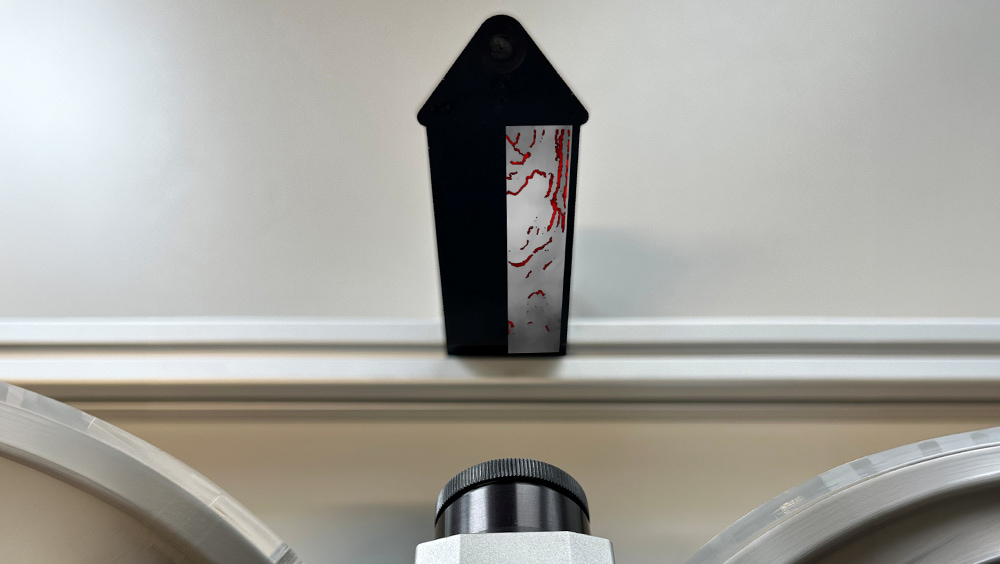
Active thermography reveals hidden material inhomogeneities: The streaks marked in red on the plastic plate are detected through thermal excitation and infrared image analysis, even though the sample appears visually flawless. (Photo: Daniel Seewald, SKZ)
Free registration is still available
As part of the TherMI project, the SKZ is developing an inline thermographic inspection technique for detecting streaks on component surfaces and inhomogeneities inside injection-molded parts. The components are selectively excited using optical or infrared radiation. Differences in absorption, emission, and reflection behavior, as well as in temperature distribution, are recorded and evaluated using an infrared camera. The goal is to develop an industry-ready, user-friendly measurement technology that can be integrated into the injection molding process.
Practical Experience Instead of Dry Theory
Following a brief update on the project’s status, participants will receive a guided tour of the SKZ’s model factory. The focus will be on a live demonstration of the TherMI measurement setup. The entire process will be shown, from the positioning and thermal excitation of a sample through recording with an infrared camera to the evaluation of the measurement data.
“With this hands-on day, we want to give companies the opportunity to experience the measurement technology firsthand and discuss specific requirements from their production processes with us,” explains Daniel Seewald, research associate in non-destructive testing at the SKZ. “Examining real components in particular helps us assess the potential and limitations of the method at an early stage.”
Bringing Your Own Samples Is Strongly Encouraged
Interested companies may bring their own plastic components or samples after prior coordination. Using selected examples, preliminary tests will determine whether the method appears fundamentally suitable for the respective task. Together with SKZ experts, participants can examine the effects of material, color, surface, and component geometry, as well as discuss requirements regarding the camera, excitation, component handling, cycle time, and process integration.
New Companies Welcome to the Project Committee
The hands-on workshop is also specifically aimed at companies that are not yet represented on the TherMI project committee. It is particularly geared toward plastics processors and injection molding companies, manufacturers and users of thermography systems, suppliers of lighting and excitation technology, equipment manufacturers, and specialists in quality assurance and testing technology.
Participation in the practical workshop is free of charge. Please register by September 9 via email with Daniel Seewald.
Event at a Glance
- Date: September 17, 2026
- Time: 10:30 a.m. to 2:30 p.m.
- SKZ – The Plastics Center, Friedrich-Bergius-Ring 22, 97076 Würzburg
- Participation: free of charge
- Registration deadline: September 9, 2026
- Registration: via email to d.seewald@skz.de
Further Information on Non-Destructive Testing
The “TherMI” project, grant number 01IF23463N, is funded by the Federal Ministry for Economic Affairs and Energy (BMWE) as part of the Industrial Collaborative Research (IGF) program.