

The KARE Competence Center Continues to Develop Transformation Modules for the Circular Economy
The partners of the KARE Competence Center met in Goslar on June 30 for their semi-annual plenary meeting. The focus was on the transformation modules currently being developed in collaboration with the companies, in whose design and further development the SKZ plays a key role. These modules are scheduled to be tested in the coming months. On the second day, there was an in-depth exchange with the KREIS Competence Center, supplemented by practical insights provided by the company Electrocycling GmbH.
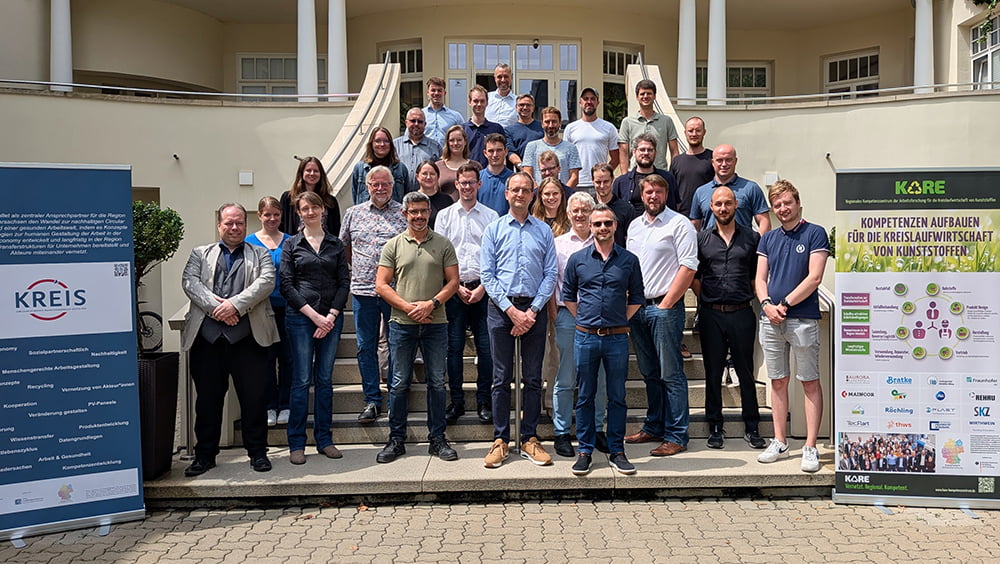
Group photo of the KARE Competence Center at the biannual project meeting, held this time in Goslar together with the KREIS Competence Center. (Photo: SKZ)
Project Meeting in Goslar: Focus on Transformation Modules
The plenary session centered on KARE’s transformation modules, which are currently under development. These modules are designed to support companies in the plastics industry with practical tools as they transition to a circular economy. The concepts are being developed in collaboration with partner companies and tested in several pilot rounds. The insights gained from these pilot applications are directly incorporated into the further development of the modules.
Practical Modules for the Transformation of the Plastics Industry
The concepts developed address various challenges of the transformation. The “Mindset Development” module helps companies involve employees early on and foster a shared commitment to sustainable practices. “Material Match” brings processors and recyclers together to utilize production waste more efficiently and establish new material cycles.
The “In-Depth Regulatory Affairs” module provides companies with support in analyzing regulatory requirements, identifying areas where action is needed, and establishing relevant structures. The “Sales Training” module teaches approaches for successfully incorporating sustainability aspects and circular economy competencies into customer communications, as well as for dispelling reservations and misunderstandings regarding recycled materials.
“Our close collaboration with our partner companies shows that the transition to a circular economy can only succeed if technical, organizational, and cultural aspects are considered together. With these transformation modules, we are creating concrete and practical support services for companies in the plastics industry,” says Jonathan Lambers, Group Leader for Transformation of the Plastics Industry at SKZ.
Exchange, Networking, and New Impulses for the Circular Economy
Another highlight of the program was a tour of the electronics recycling company Electrocycling. The plant tour provided vivid insights into the recovery of valuable raw materials and the associated labor-intensive manual sorting and disassembly work. In addition, the second day offered an opportunity for professional exchange with the KREIS Competence Center, which, like KARE, is funded as part of the “Future of Value Creation—Research on Production, Services, and Work” program.
During the session, cross-industry commonalities and potential points of connection for future collaborations were identified. The plenary meeting was rounded off by a presentation on “Design 4 Sustainability,” which provided insights into the importance of sustainability-oriented product development for the circular economy.
About KARE
The KARE research project—the KARE Competence Center for Labor Research: Building Competencies for the Circular Economy of Plastics—supports companies in the plastics industry in successfully shaping the transformation toward a circular value chain. Together with companies, research institutions, and other stakeholders, the consortium develops practical solutions, training programs, and transformation modules that support employees and organizations through the technical, organizational, and cultural changes associated with the circular economy. One example is the free livestream series “KARE Talks – Knowledge for Transformation,” which presents regulatory and technological innovations on a monthly basis.
KARE is funded by the Federal Ministry of Research, Technology, and Space (BMFTR) as part of the program “The Future of Value Creation – Research on Production, Services, and Work” (grant number: 02L22C200) and is managed by the Project Management Agency Karlsruhe (PTKA).