

Targeted Analysis of Residual Stresses in Plastics
Residual stresses often influence the behavior of plastic components more than expected. They arise during processing and remain in the component. The SKZ Plastics Center offers the borehole method, a testing procedure for quantitatively evaluating stress states.
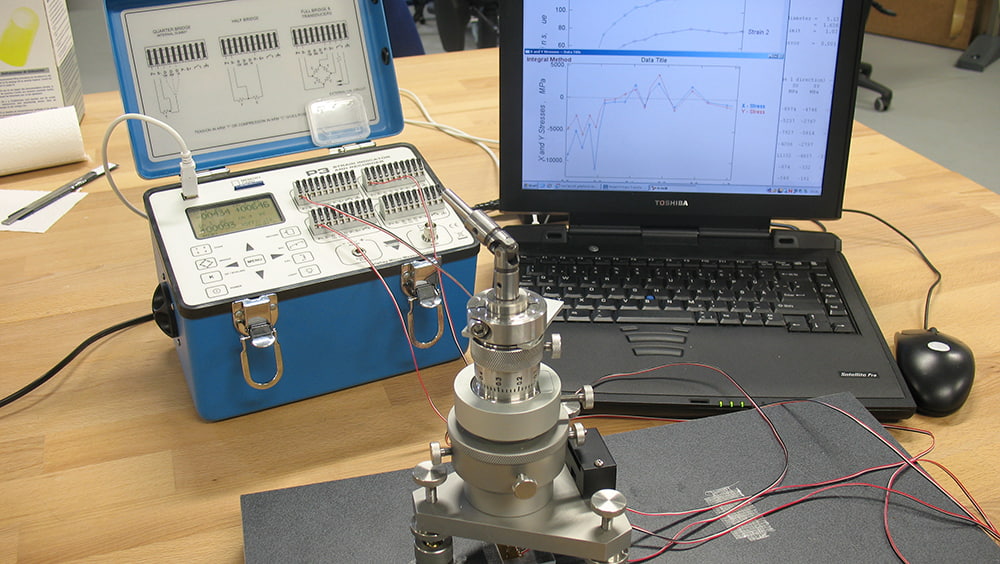
Borehole method for the incremental determination of residual stresses. (Photo: SKZ)
Borehole Method at SKZ Enables Quantitative Assessment of Stress States in Plastic Components
Residual stresses are a frequently underestimated factor affecting the service life and functional safety of plastic components. They arise, among other things, during processing—such as injection molding or extrusion—due to inhomogeneous cooling, flow processes, or local constraints. If these stresses remain undetected, they can lead to warping, dimensional deviations, or—in the worst-case scenario—premature failure of the components—especially under mechanical, thermal, or chemical stress.
Small Drill Hole, Big Insights
To investigate residual stresses in plastics, the SKZ offers the mechanical drill-hole method. This method enables the quantitative determination of residual stresses. A small blind hole is drilled into the component’s surface, which partially relieves locally present stresses. The resulting changes in strain are recorded in different directions using strain gauges and evaluated mathematically.
Precisely determining principal stresses and their depth profile
In this way, principal stresses—and, when using an incremental approach, their depth distribution near the surface—can be determined. To support the analysis, stress-optical examinations can be used as needed to visually illustrate stress states and specifically pinpoint critical component areas.
A Solid Foundation for Damage Analysis and Component Safety
The borehole method is particularly well-suited for applications requiring reliable numerical data to assess component safety, analyze the causes of damage, or validate design and manufacturing processes. It can be applied to actual components and provides a solid foundation for further technical decisions.
“Residual stresses are present in many plastic components without being immediately visible in everyday use. However, they can significantly influence component behavior and long-term durability. With the borehole method, the SKZ has a procedure available to analyze stress states in a targeted and quantitative manner and to derive well-founded assessments,” says Dr. Mirko Wenzel, Expert Scientist at the SKZ.
More information about the SKZ Research Group on Component Properties