

Strengthening International Plastics Expertise: SKZ Brings Recycling Know-How to Africa Through the RECAP Project
As part of the RECAP project, SKZ experts provided professionals in Tunisia and Senegal with practical recycling know-how covering the entire plastics value chain—with a particular focus on understanding materials, processes, and their impact on quality.
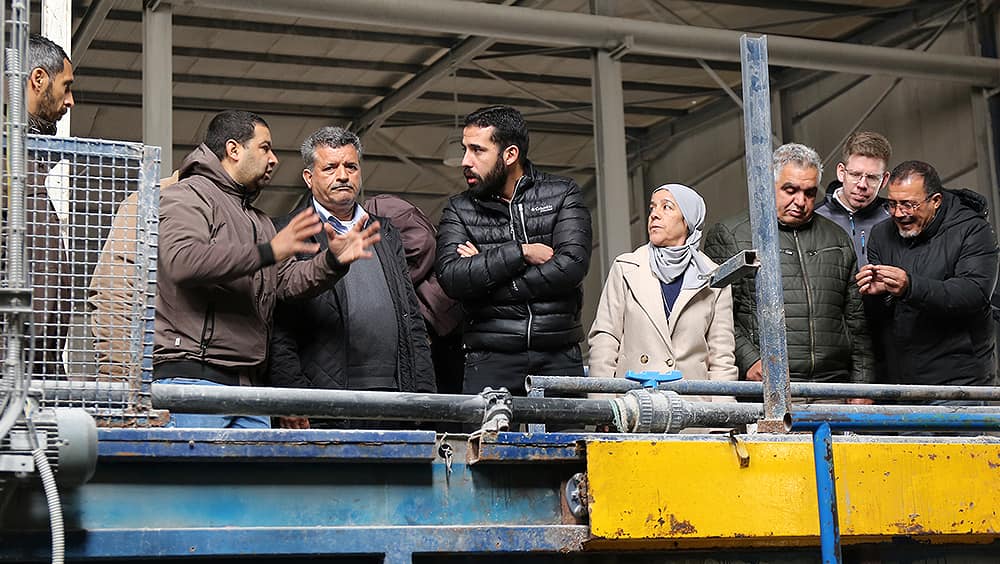
Hands-on plant tour at Valorflakes (Zaghouan): Participants discuss the steps in the plastic recycling process right at the plant. | Source: bbw
Plastics Recycling Requires More Than Just Technology
Efforts to establish functioning plastics recycling loops are being advanced worldwide. In practice, however, it has become clear that recycling often fails not because of a lack of technology, but primarily due to a lack of understanding of material properties and process interdependencies.
This is precisely where the project “RECAP – Promoting Plastics Recycling in Tunisia and Senegal” comes in. Implemented by the Bildungswerk der Bayerischen Wirtschaft (bbw) gGmbH in collaboration with the SKZ Plastics Center and local partners, the project runs from July 2025 to June 2027 and is funded by the Bavarian State Chancellery. The goal is to establish sustainable local recycling structures through targeted training.
Needs Assessment as the First Step in the Project
Even before the training sessions began, SKZ experts Hermann Achenbach (Senegal) and Philipp Wohlfahrt (Tunisia) from the Sustainability and Circular Economy Group conducted an on-site needs assessment. Together with local partners, they identified existing recycling structures as well as specific challenges and training needs. The results were directly incorporated into the design of the training content, ensuring a practical connection to regional requirements.
On-site Training in Tunis and Dakar
In the spring of 2026, SKZ trainers Marco Rabensteiner and Mathias Ruckdeschel conducted training sessions in Tunis (Tunisia) and Dakar (Senegal).
The target audience consisted of professionals from across the entire waste and recycling chain—from collection and sorting to pre-treatment and further processing. The participants’ educational backgrounds ranged from practical experience to academic training.
“Sustainable success in plastics recycling depends crucially on understanding the relationships between material, pre-treatment, and subsequent processing. We specifically aimed to build this understanding during the training sessions,” explains SKZ trainer Marco Rabensteiner.
Designed from Materials Science to Processing
The training content was consistently aligned with the real-world requirements along the value chain.
Topics covered included:
- Fundamentals of plastics and materials science
- Plastics identification—manual and automated
- Process steps from collection through sorting and shredding to preparation
- Regranulation, including material preparation, additive incorporation, and filtration
- Fundamentals of relevant process parameters for quality assurance
- Further processing, including extrusion, injection molding, and thermoforming
A special focus was placed on typical material streams such as PE, PP, PET, or PS/ABS, as well as their behavior in the recycling process.
Practical relevance through real material flows and facilities
In addition to theoretical instruction, practical relevance played a central role.
In Tunisia, participants were able to tour recycling facilities and observe real process steps—from incoming goods inspection to processing.
In Senegal, the example of the Mbeubeuss landfill highlighted the challenges that still exist in establishing functioning plastic recycling loops.
Participants analyzed the material flows generated there and discussed the impact of limited collection, sorting, and recovery structures on the quality of potential recycled materials.
Train-the-Trainer for Sustainable Impact
A key component of the project was the train-the-trainer approach.
In addition to technical expertise, the program therefore also covered the fundamentals of knowledge transfer. The goal is for participants to independently pass on their knowledge and thus build long-term capacity in the regions.
Different Contextual Conditions—Same Challenges
The training sessions clearly demonstrated that while the contextual conditions in Tunisia and Senegal differ, the core challenges are comparable.
In particular, fluctuating material quality, a lack of process reliability, and limited knowledge of interdependencies along the value chain make it difficult to establish stable recycling processes.
Knowledge as the Key to Functioning Circular Systems
Feedback from participants shows that, in particular, a better understanding of material and process interrelationships offers direct added value.
Participants were able to more clearly understand the connections between material quality, preparation, and processing and apply this knowledge to their own practices. At the same time, the training sessions fostered exchange among stakeholders and contributed to networking along the plastics value chain.
Conclusion: Building Expertise as the Foundation of the Circular Economy
The RECAP project demonstrates that establishing functional plastic circular economies is not solely a matter of infrastructure.
Above all, building expertise along the entire value chain is crucial.
Through their commitment, the SKZ and its partners are making an important contribution to the international training of skilled workers, thereby laying the groundwork for sustainable and stable recycling structures.