
SoliD-Q Project: Using AI and Data to Produce Better Recycled Materials
In the “SoliD-Q” project, the SKZ Plastics Center, in collaboration with WeSort.AI GmbH and Hoffmann + Voss GmbH, is demonstrating how AI-assisted sorting, data-driven compounding, and digital quality verification can significantly improve the quality of recycled materials. The focus is on the intelligent integration of sorting, process, and quality data throughout the entire value chain—with the goal of economically providing high-purity PCR materials with batch-specific properties and a digital fingerprint.
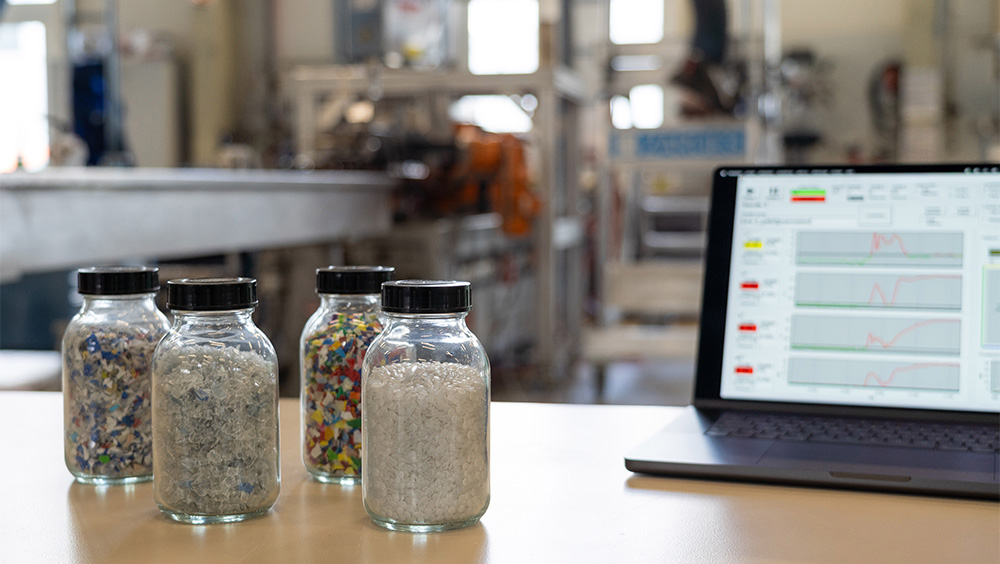
SoliD-Q Collaboration Project: AI and data are being used to improve recycled materials. (Photo: Luca Hoffmannbeck, SKZ)
Data-Driven Compounding of PCR Materials Through Object-Based Sorting
The industry-driven collaborative project “SoliD-Q” is fundamentally rethinking the flow of information in recycling. By systematically integrating data from sorting, processing, and quality assurance, the production of high-quality post-consumer recycled (PCR) materials becomes not only more precise but also more efficient. The goal is a seamless digital product passport that begins as early as the sorting stage. The project launched in February 2026.
High-purity fractions through object-based sorting
“Through object-based sorting, we reliably separate, for example, HDPE shampoo bottles from food packaging made of the same material. This results in high-purity fractions with clearly defined product quality,” says Johannes Laier, Managing Director of WeSort.AI.
The project is being implemented by a consortium comprising WeSort.AI, Hoffmann + Voss, and SKZ, with each partner contributing its specific expertise. The goal is a demonstrator that provides high-purity PCR materials with immediately available quality parameters specified down to the batch level. At the same time, optimized processing parameters enable significantly greater economic efficiency in mechanical recycling.
From Waste to Precise Data Point
SoliD-Q is based on the interaction of three subprojects: WeSort.AI is developing AI-supported object recognition for product-specific sorting of plastic waste. “A key challenge is training the system to reliably recognize packaging despite contamination and deformation,” says Laier.
Hoffmann + Voss uses the sorting data obtained to optimize the compounding process. “Converting sorting data into optimal process parameters is complex, but offers enormous potential,” explains Ansgar Hoffmann, Head of R&D/Production at Hoffmann + Voss.
The SKZ, in turn, derives a digital quality certificate from the process data. “It is crucial to view all available data holistically and to reliably capture fluctuations in material properties,” says Mingo Kübert, Scientist Digitalization at SKZ. The results are stored in an infrastructure for the digital product passport with audit-proof hash validation and are thus available not only in real time but also in a tamper-proof format.
Data-Driven Quality as the New Standard in Recycling
Traditional laboratory samples often provide only isolated spot checks—with corresponding uncertainties. SoliD-Q, on the other hand, enables continuous data collection for every batch. The result is recycled materials with consistent, traceable properties. This strengthens confidence in PCR materials while simultaneously increasing value creation along the entire recycling chain.
About the Project
This project, with funding code KK6028306FM5, is funded from February 1, 2026, to July 31, 2028, as part of the Central Innovation Program for SMEs (ZIM) of the Federal Ministry for Economic Affairs and Energy (BMWE).