
SKZ and WITTMANN Overcome the Technological Challenges of Foam Injection Molding
For the past eight years, the SKZ Plastics Center and WITTMANN have been jointly building expertise in foam injection molding. This close collaboration is helping to continuously advance methods for inline quality assurance and non-destructive testing of foamed components. A recent technical presentation demonstrated how foaming processes and the internal structure of components can be evaluated even more effectively in the future.
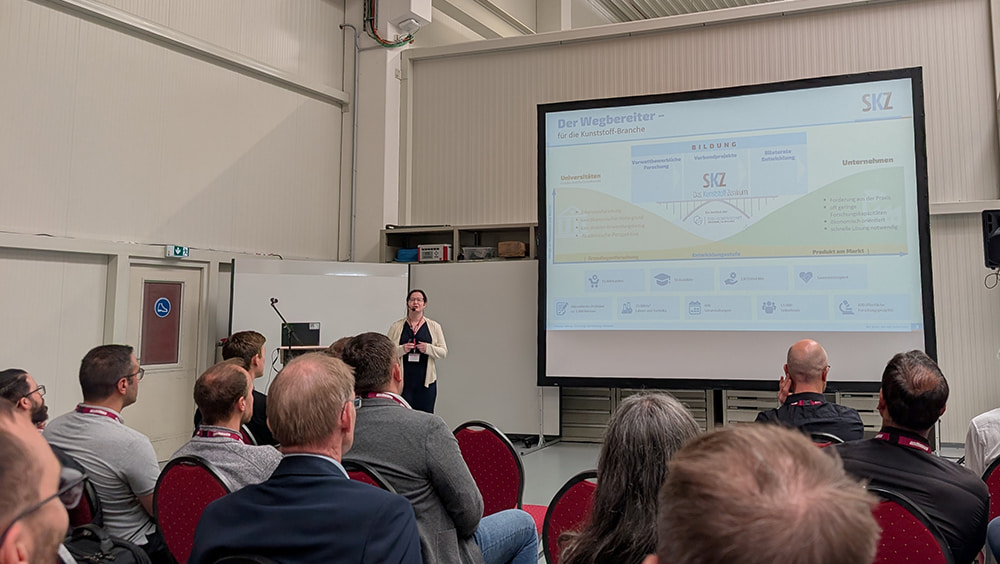
The SKZ presentation “Non-Destructive Testing of Foamed Components” by Anika Fuhrmann drew a great deal of interest. (Photo: Christoph Mussauer, SKZ)
Technical Presentation Highlights Approaches to Inline Quality Assurance and Non-Destructive Testing of Foamed Components
Foamed plastic components offer great potential for resource-efficient and cost-effective production. By specifically reducing component density, weight and material usage can be minimized. At the same time, the internal foam structure poses special challenges for process monitoring and component inspection, as critical quality characteristics are not immediately visible from the outside.
The long-standing collaboration between WITTMANN and the SKZ is dedicated to addressing precisely these challenges. Together, they are developing solutions to better understand foaming processes, optimize process parameters in a targeted manner, and reliably evaluate the quality of foamed components. The SKZ recently provided insight into current developments at the WITTMANN Expert Day on “Foam Injection Molding and Gas-Assisted Molding,” where users, machine manufacturers, material suppliers, mold makers, and research institutions came together to exchange ideas on new approaches and practical examples.
Non-Destructive Evaluation of the Internal Structures of Foamed Components
A key highlight of the program was the technical presentation “Non-Destructive Testing of Foamed Components” by Anika Fuhrmann, Senior Engineer in the Injection Molding Research Department at SKZ. The focus was on how quality characteristics can be captured during the process itself and how the internal structures of foamed components can be evaluated non-destructively. Inline thermography and mold cavity pressure were presented for process monitoring, along with hyperspectral imaging and wave-based testing methods for component characterization.
Application examples included the early detection of thermally induced defects and the evaluation of process-relevant factors via mold cavity pressure. For wave-based methods, the example of structure-borne sound was used to demonstrate the potential for determining bulk density, defects, and—in the future—the actual foam structure.
“WITTMANN and the SKZ have been jointly advancing foam injection molding for eight years. Combining machine and process expertise with application-oriented research helps us better understand the processes involved and develop suitable solutions for the industry,” emphasizes Anika Fuhrmann.
Better Understanding of Foaming Processes
In addition to the technical presentation, the SKZ was also represented in live demonstrations. Christoph Mussauer, Group Leader of the Injection Molding Technical Center at the SKZ, demonstrated the use of thermography on foamed plastic components. The hands-on demonstration illustrated how complementary analytical methods can be used to better understand foaming processes and to drive technological developments in a targeted manner.
The collaboration between WITTMANN and the SKZ extends far beyond individual technical events. Through joint development efforts, close collaboration with industry and research, and the transfer of knowledge to the industry, new solutions for foam injection molding are being developed. This collaboration also focuses on the future potential of the technology, such as expanding the range of materials from recycled plastics to high-performance thermoplastics for demanding applications.
The ongoing exchange with industry partners provides important impetus for the further development of the technology. For SKZ and WITTMANN, the close integration of research, machine technology, industrial application, and knowledge transfer remains a key factor for success. Next year, SKZ will once again offer a course on thermoplastic foam injection molding to transfer new and proven concepts to the industry in a practical manner.
Further information on the Injection Molding Research Division