
New Testing Methods for Long-Lasting Welded Joints
How can the long-term properties of plastic welded joints be reliably tested in the future if established testing methods are no longer available? In the “DuraWeld” research project, the SKZ Plastics Center is investigating innovative testing methods to characterize the stress crack resistance of polyethylene heating element butt welds (HS)—for example, for plastic piping systems.
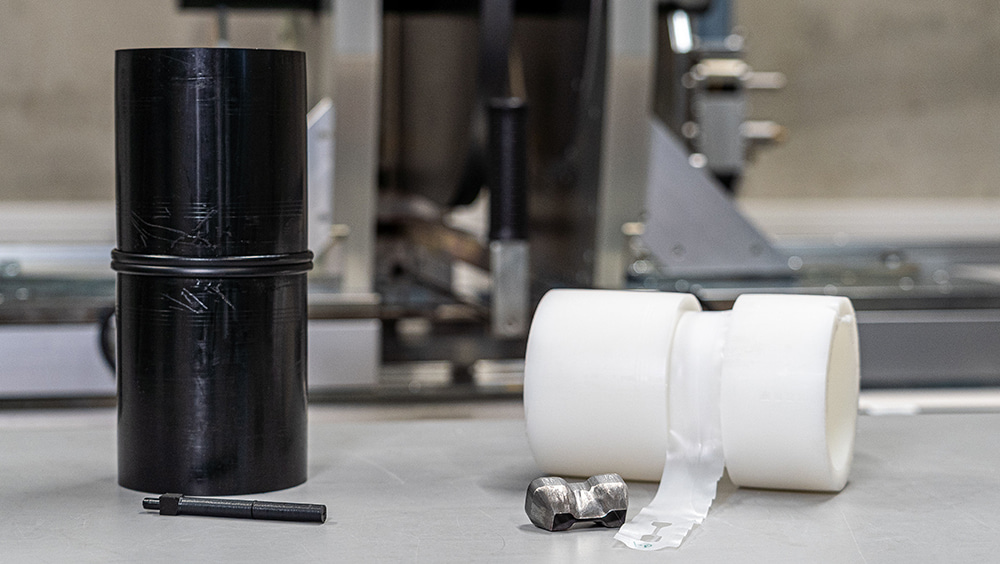
Test specimens for evaluating the stress-crack resistance of butt welds in heating elements. (Photo: Luca Hoffmannbeck, SKZ)
Alternatives for Determining Stress Crack Resistance – SKZ Launches New Research Project
Plastic pipes are an indispensable component of modern gas, water, and energy supply networks. Since these systems are designed for service lives of up to 100 years, the quality of their welded joints is crucial. When assessing long-term properties, slow crack growth (SCG) must be considered a critical failure mechanism in polyethylene components.
With “DuraWeld,” the SKZ is driving the development of new testing methods for welded joints. In this two-year research project, researchers are investigating how the resistance of butt welds to slow crack growth (SCG) can be reliably assessed even without the previously established test medium Arkopal® N 100. In doing so, the SKZ is laying the groundwork for a long-term, reliable, and robust assessment of the long-term durability of welded joints.
Further Development of Established Test Methods
The research project focuses on the Strain Hardening Test (SHT, ISO 18488) and the Cracked Round Bar (CRB) Test (ISO 18489). Both test methods have proven effective in evaluating the stress crack resistance of polyethylene materials for piping systems and are now to be specifically further developed for the investigation of butt welds in heating elements.
“With the SHT and CRB tests, we are exploring two approaches that do not require a test medium and, at the same time, open up new possibilities for a faster and more nuanced evaluation of welds,” explains Tobias Eckhardt, a research associate at SKZ in the Thermal Joining Group.
Invitation to Participate in the Project
Companies can actively contribute to the research project: On the project steering committee, representatives from industry and the field have the opportunity to contribute their expertise and monitor the research work. Companies along the entire value chain are invited to participate—from material and semi-finished product manufacturers to welding machine manufacturers and testing service providers, all the way to gas and water utility operators. Participation is free of charge and non-binding.
The “DuraWeld” research project (grant number 01IF25021N) is funded by the Federal Ministry for Economic Affairs and Energy (BMWE) as part of the Industrial Collaborative Research (IGF) program. The project is managed by the German Aerospace Center (DLR).