

New Rules for Green Environmental Claims: What Companies Will Still Be Allowed to Communicate Starting in September 2026
Starting September 27, 2026, stricter rules will apply to green environmental claims. Many sustainability claims that have been common practice up to now—such as “sustainable,” “environmentally friendly,” or “climate-neutral”—will largely be prohibited. The SKZ outlines which claims will be permitted in the future and supports companies in communicating their sustainability efforts credibly.
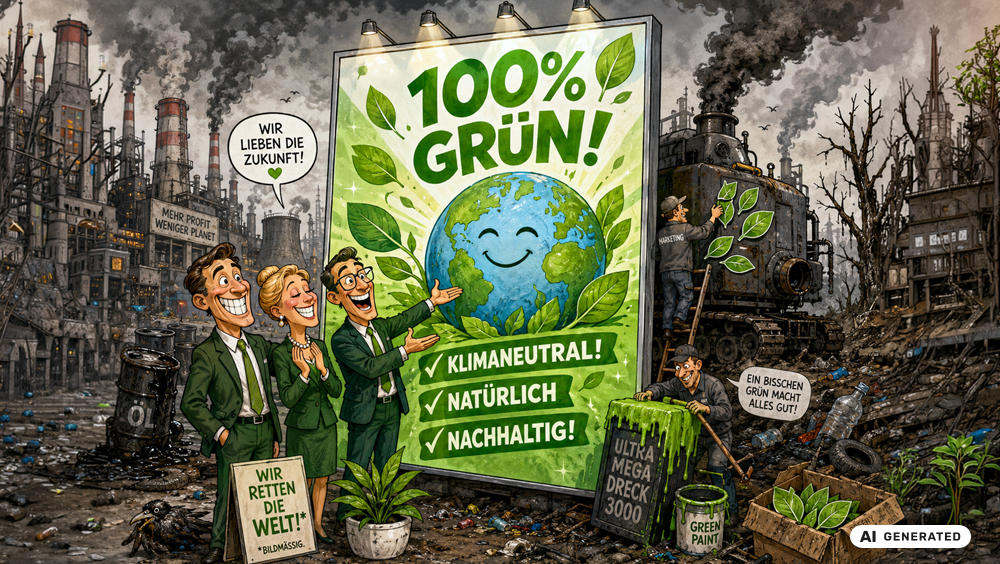
Stricter regulations against greenwashing make precise and verifiable sustainability communication mandatory (Image: AI-generated using ChatGPT (OpenAI))
Starting September 27, 2026, new legal requirements for environmental claims will take effect in Germany. By implementing the EU directive “Empowering Consumers for the Green Transition” (EmpCo) into the “Law Against Unfair Competition” (UWG), lawmakers are significantly tightening the requirements for so-called green claims. The goal is to curb greenwashing and provide consumers with reliable, transparent information to support sustainable purchasing decisions.
General environmental claims will be permitted only to a limited extent in the future
For companies in the plastics industry, as well as for numerous other sectors, this represents a fundamental shift in communication. Many statements that have been common practice until now—such as “sustainable,” “environmentally friendly,” “green,” or “climate-friendly”—will only be permitted to a very limited extent in the future. These environmental claims, referred to as “general,” are generally considered insufficiently substantiated unless they are supported by relevant certificates or quality labels.
Specific claims such as “25% of this product’s packaging is made from recycled material” remain permissible even without a certificate, as long as it is clearly communicated which environmental aspect is addressed, to which stage of the product life cycle the claim refers, and what specifically accounts for the claimed improvement. Non-specific claims such as “Up to 25% recycled content” also end up on the “blacklist” of generally prohibited business practices, just like misleading claims regarding durability or repairability.
Climate neutrality claims and future environmental goals are coming under particular pressure
The restrictions on claims regarding climate neutrality are particularly far-reaching. Advertising claims such as “climate neutral,” “climate positive,” or similar phrasing based on CO₂ offset measures will be largely prohibited in the future. Instead, companies must emphasize actual and verifiable emissions reductions. In the future, climate-neutral products may only be labeled as such if CO₂ is stored directly within the product, which in practice requires the use of renewable raw materials as well as meeting additional criteria.
Statements regarding future environmental performance—such as targeted recycling rates or greenhouse gas reduction goals—will also be subject to strict requirements in the future. Here, the EmpCo requires that these goals be based on clear, objective, and verifiable measures, be set out in a detailed and realistic implementation plan, and be regularly reviewed by independent experts. Not only the plan but also the results of the progress review must be made available to consumers. In this regard, the SKZ assists, on the one hand, in the development of a suitable action plan for greenhouse gas reduction for the Science Based Targets initiative (SBTi) and, on the other hand, can act as an independent oversight body to monitor progress toward recycling targets.
Companies should review their communications now
For many companies, the changes to the UWG create an urgent need for action. Websites, product data sheets, packaging, brochures, sales materials, and social media content should be reviewed in a timely manner. Unlike many regulatory changes, the law does not provide for a grace period for existing labeling. This means that, as of September 27, 2026, it will be prohibited to place on the market even packaging produced in advance that contains impermissible environmental claims. Consumer advocacy groups and competitors may take legal action against impermissible environmental claims as of that date.
“What is a major gain in transparency from the consumer’s perspective is a challenge for companies that should not be underestimated. At the same time, this also presents a great opportunity for products with genuine environmental benefits: After all, those who can back up their claims with facts not only reduce legal risks but also build trust among customers and business partners,” explains Philipp Wohlfahrt, a scientist in the Sustainability and Circular Economy division at SKZ.
To ensure that companies can successfully capitalize on the opportunities presented by sustainable products even under the new framework conditions, the SKZ supports them in developing credible sustainability communications. The services range from evaluating existing claims to developing robust environmental claims and preparing well-founded environmental life cycle assessments. In addition, the experts advise on appropriate certifications and assist companies with data collection, documentation, and the design of action plans.