

Less Waste, More Raw Materials: LaMa Recycling GmbH Launches an Innovative Approach for Plastic Products Containing Superabsorbents
Construction products that were previously non-recyclable are being transformed back into valuable raw materials: The newly founded LaMa Recycling GmbH has developed a process that, for the first time, allows plastic products containing superabsorbents to be economically processed into high-quality regranulate. The Würzburg-based company is thus tapping into a previously unaddressed material stream for the circular economy and will present its technology for the first time in October at Fakuma in Friedrichshafen.
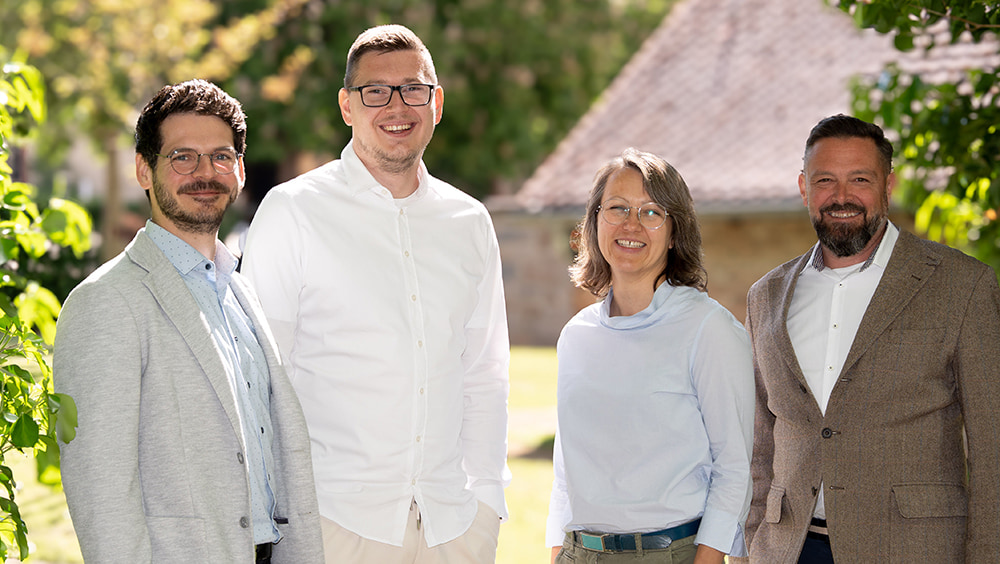
Dr. Lars Helmlinger, Stefan Zuljevic, Dr. Marieluise Lang, and Thomas Wolz (from left) of LaMa Recycling. (Photo: LaMa Recycling GmbH)
SKZ Spin-off Tackles a Previously Unsolved Recycling Problem in the Construction Industry – Exhibition Appearance in October at Fakuma
Superabsorbent polymers (SAP) are widely used in the construction industry—they are found in drainage membranes, sealing mats, geotextiles, and other construction products used wherever water needs to be drained in a controlled manner or permanently kept out. Once these products reach the end of their useful life, processing them currently poses insurmountable challenges for the recycling industry: The combination of plastic carrier material and superabsorbent makes processing using conventional methods impossible.
The solution: a patented process yielding ready-to-use regranulate
LaMa Recycling GmbH has developed a customized recycling process—for which a patent has been filed—that represents a decisive breakthrough: Plastic products containing superabsorbents are processed into high-quality regranulate that can be reused in production—without the superabsorbent interfering with the recycling process. What was previously considered non-recyclable thus becomes a secondary raw material.
Ready for scaling: 200 kg/h with reliable production
What many recycling technologies still have ahead of them, LaMa Recycling GmbH has already achieved: The processing works not only in the lab but also reliably on an industrial scale. With a throughput of 200 kg/h, the company is ready to bring the technology to market—and thereby tap into a material stream for which there has been no economical solution to date.
Founded with a Mission—and Strong Backing
“We’re convinced that the circular economy will only work if we find solutions even for the difficult material streams,” says Dr. Marieluise Lang, co-founder of LaMa Recycling GmbH. “Construction products containing superabsorbents are exactly such a case—and we’ve set out to solve it. With our technology, however, we can also process other technical materials. We’re learning every day just how much is possible.”
The company was founded by Dr. Lars Helmlinger, Dr. Marieluise Lang, and Thomas Wolz. Based at the SKZ Plastics Center in Würzburg, LaMa Recycling GmbH is part of an innovation-driven environment for research, development, and technology transfer in the plastics industry. This proximity to academia and industry supports the further development and market launch of the new recycling technology.
The technology is also receiving funding through mid-2027 as part of the EXIST Technology Transfer program—one of Germany’s most prestigious funding programs for transferring cutting-edge technologies from academia to the market.
Exhibition at Fakuma in October
In October 2026, LaMa Recycling GmbH will be represented for the first time at the Bayern Innovativ joint booth at Fakuma in Friedrichshafen. Interested parties from industry, research, and the field will have the opportunity there to meet the team and learn more about the technology and the business model. “Fakuma is the ideal platform for engaging with potential partners and customers,” says Thomas Wolz. “We look forward to the exchange.”
About LaMa Recycling GmbH
LaMa Recycling GmbH was founded on March 13, 2026, and is headquartered at the SKZ in Würzburg. The company develops and operates patented processes for the recycling of plastic products containing superabsorbents, particularly those from the construction sector, and is receiving funding through the EXIST Technology Transfer program until mid-2027.