

Launch of the “KlimRa” Project by SKZ and TRILITEC
How can the curing of adhesives and sealants be monitored quickly, reliably, and non-destructively? The new “KlimRa” research project is dedicated to addressing this question. TRILITEC GmbH and the SKZ Plastics Center are collaborating to develop a mobile microwave radar sensor designed to make production processes more efficient, sustainable, and safer. Companies can already actively contribute to the project by sharing their own use cases.
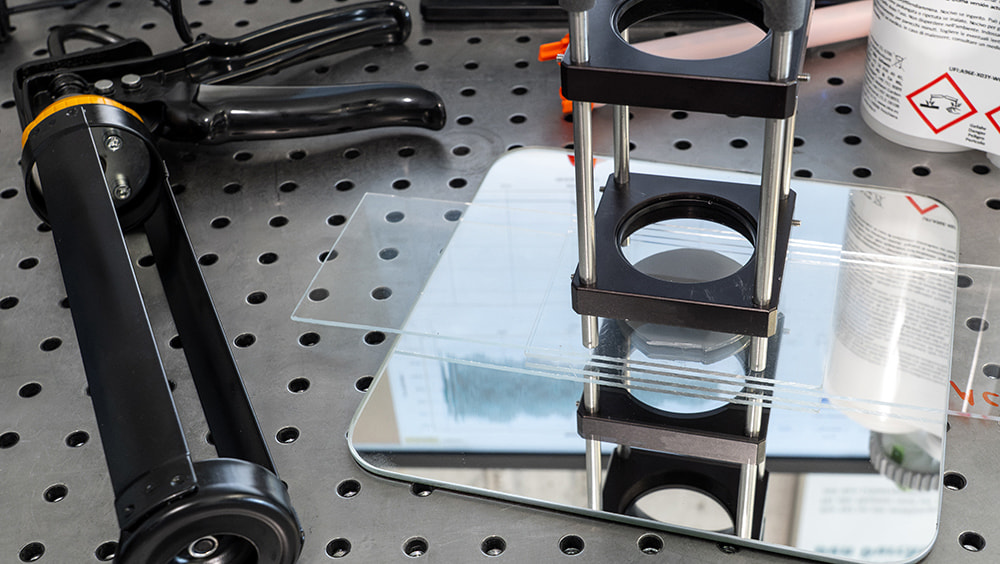
Microwave radar sensor used to measure the curing of an adhesive. (Photo: Luca Hoffmannbeck, SKZ)
Research Project Develops Mobile Microwave Radar Sensor for Monitoring Adhesive and Sealant Processes
With the launch of the “KlimRa” research project (Development of a Microwave Radar Sensor for Inline Monitoring of the Curing of Applied Composite Materials in Industrial Applications), TRILITEC GmbH from Bremen and the SKZ Plastics Center from Würzburg are pooling their expertise in radar and plastics technology. The goal of the project is to develop a mobile, hand-held microwave radar sensor capable of non-destructively determining the curing status of adhesives, sealants, and composite materials directly on the component.
Real-Time Monitoring
In the future, the sensor will enable users to monitor the progress of curing processes in real time. In addition, other important quality characteristics, such as layer thicknesses or potential bonding defects, can be detected. This allows for more targeted control of production processes, reduces material consumption, and prevents scrap at an early stage. At the same time, waiting times between individual process steps can be shortened.
“With this research project, we aim to develop a measurement technology that, for the first time, enables users to perform mobile and simple quality control during bonding and composite processes,” says Benjamin Littau, Managing Director of TRILITEC GmbH. “This will ultimately conserve resources, reduce production costs, and simultaneously increase process reliability.”
Development of a Robust and Practical Sensor System
The project builds on previously successful research conducted by the SKZ on monitoring adhesive curing using microwave and terahertz technologies. Building on these findings, the goal is now to develop a robust and practical sensor system that can be deployed directly in industrial environments.
Potential applications range from quality control in manufacturing processes to the monitoring of fire-resistant sealants and integration into automated production lines. Several industrial companies are already showing great interest in the technology and are supporting the project with concrete application scenarios.
“Through our broad network in the plastics and manufacturing industries, we aim to closely align the development with the actual requirements of companies,” explains project manager Pierre Pfeffer from SKZ. “Direct exchange with users is particularly important to us in order to create practical solutions.”
Companies Can Actively Help Shape the Project
The project partners plan to evaluate selected application scenarios together with interested companies and tailor the development of the measurement system specifically to their needs. This will allow potential users to benefit from the project results at an early stage and actively help shape the future technology. We are particularly seeking companies that use adhesives, sealants, or composite materials and are interested in more efficient, resource-conserving, and non-destructive quality monitoring.
Interested companies are invited to contact the project team.
Funding
The “KlimRa” project, funding number 40525/01, is funded by the German Federal Environmental Foundation (DBU).
Further information on the SKZ Research Group for Non-Destructive Testing