
Rising Quality Standards for Safe Dog Toys in Europe
The SKZ Plastics Center is consistently expanding its commitment to the safety of pet products: With the awarding of the SKZ seal of approval to TÖYS-Hundespielzeug Manufaktur GmbH of Gunskirchen, an Austrian manufacturer has been honored with this independent quality seal for the first time. The ceremonial presentation took place in July as part of the 2nd SKZ Customer Day: Testing | Monitoring | Certification in Würzburg. With this development, the SKZ’s testing program continues to expand beyond Germany’s borders and is increasingly establishing itself as a European quality standard for safe dog toys.
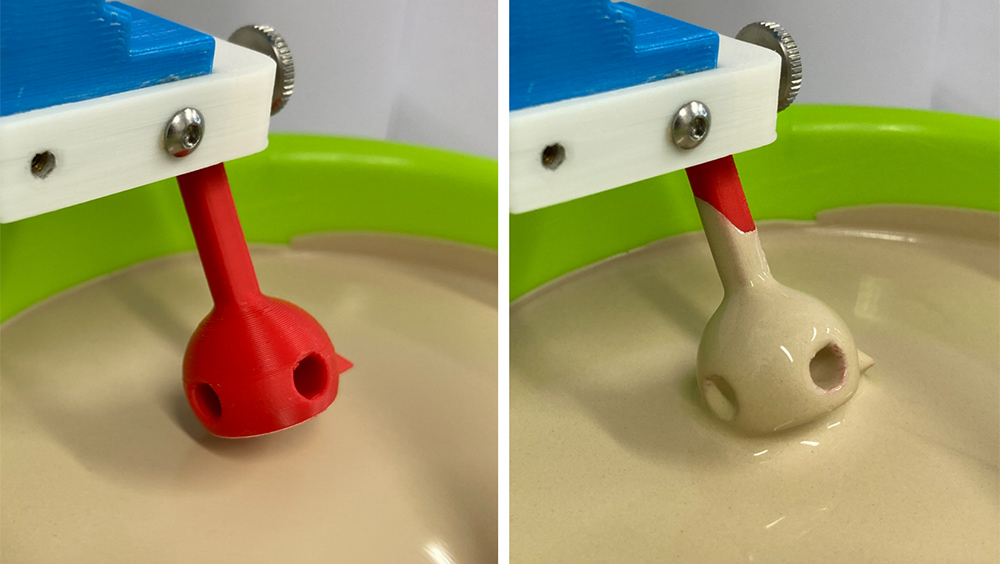
An FLM-manufactured test specimen before (left) and after (right) coating with the developed ceramic slurry. (Photo: Dr. Alena Stein, FGK)
SKZ and FGK Are Researching a New Approach to Optimizing FLM Components
Additive manufacturing has emerged in recent years as a key technology in industrial production. Fused Layer Modeling (FLM), in particular, is characterized by very low entry costs and a very wide range of available materials. Nevertheless, its industrial application remains limited compared to other additive manufacturing processes: Typical challenges include pronounced anisotropy and internal defects, which lead to reduced mechanical properties of the components.
This is where the joint research project “CerAM-Coating” by the SKZ Plastics Center and the Research Institute for Glass | Ceramics (FGK) comes in. The focus is on developing a specially formulated, water-based, and rheologically optimized ceramic slurry that serves as a dimensionally stable support structure during the thermal post-treatment of additively manufactured plastic components.
Multi-step Approach
The process is based on a multi-step approach: First, plastic components manufactured using FLM are completely coated with the slurry. After drying, a coating forms that subsequently acts as a dimensionally stable ceramic shell.
This is followed by thermal post-processing, during which the polymer is selectively melted. As the material flows, pores and defects are sealed, and the individual layers are fused together, resulting in nearly isotropic properties. At the same time, the ceramic coating ensures that the geometry and surface quality of the components are preserved throughout the entire process.
Significant Improvement in the Mechanical Properties of FLM Components
After the polymer has cooled and solidified again, the ceramic layer is removed, resulting in components with increased density and improved isotropy. Overall, this innovative approach is expected to enable a significant improvement in the mechanical properties of FLM components and thus represents a decisive step toward the use of this technology for functional, high-load applications.
Focus on SMEs
The project is specifically aimed at small and medium-sized enterprises (SMEs). These companies benefit from pre-competitive access to the research results as well as from the practical development of the post-treatment process. This opens up new application possibilities, particularly through the improvement of the mechanical properties and component quality of FLM parts, thereby significantly expanding their use as functional components.
Interested companies are invited to participate free of charge in the project steering committee. They will have the opportunity to actively contribute industrial requirements and their own use cases, help shape the development, and benefit early on from the results and their economic potential.
Further Information on Additive Manufacturing
The “CerAM-Coating” project (project number 01IF23527N) is funded by the Federal Ministry for Economic Affairs and Energy (BMWE) as part of the Joint Industrial Research (IGF) program.