
HT NMR Opens Up New Possibilities for High-Temperature Plastics Analysis
The SKZ Plastics Center and the Fraunhofer Institute for Integrated Circuits IIS have successfully developed a novel analytical method for plastics as part of the research project “Use of High-Temperature Nuclear Magnetic Resonance for Improved Plastics Analysis (HT NMR).” The high-temperature NMR system enables fast and precise analysis of plastics at temperatures up to 300 °C—without the need for time-consuming sample preparation. This provides the plastics industry with a significantly more efficient approach to material characterization, quality control, and process optimization.
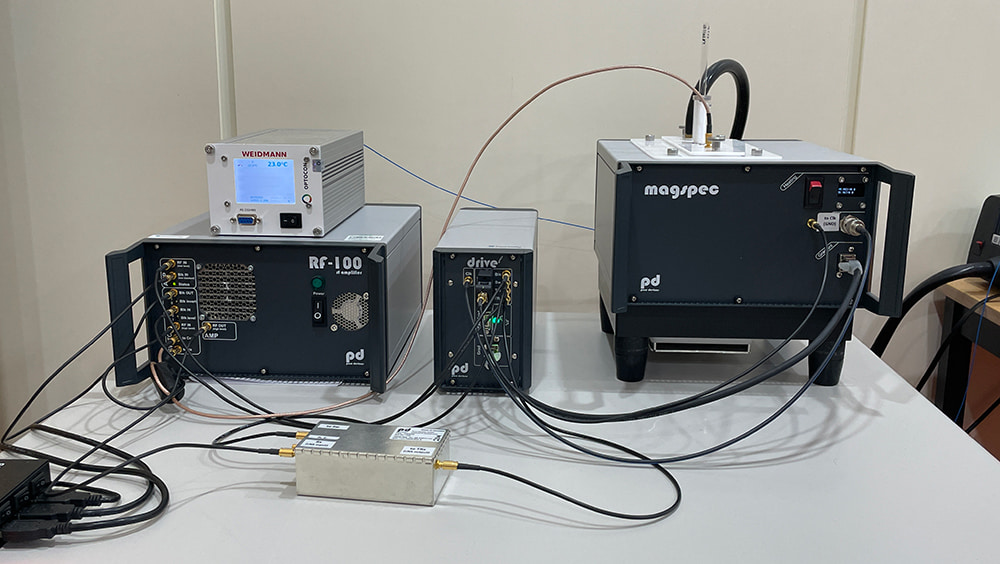
The method developed in the project is based on a benchtop device for measuring magnetic resonance (NMR), which, when coupled with a heating unit, outputs a time-resolved signal during the heating process. This signal can be converted into the rigidity index and used for material characterization. (Photo: Daniel Haddad, Fraunhofer IIS)
SKZ and Fraunhofer IIS Develop High-Temperature NMR for Precise Plastics Analysis Up to 300 °C
In modern plastics manufacturing and processing, precise yet efficient analytical methods are crucial for ensuring material quality and competitiveness. While methods such as differential scanning calorimetry (DSC) for determining thermal properties, or rheological and mechanical testing methods, provide established parameters, they often reach their limits in practice. In particular, the high effort required for sample preparation is time-consuming and adversely affects reproducibility.
HT-NMR makes material changes directly visible
The method developed in the project is based on a benchtop device for measuring magnetic nuclear spin resonance (NMR), which, when coupled with a heating unit, outputs a time-resolved signal revealing the molecular structure during the heating process. Through a specially developed method for evaluating this signal, thermal influences on the molecular structure within the material can be directly investigated.
In particular, softening effects such as glass transitions and melting effects in plastics, as well as curing mechanisms in adhesives, are analyzed. Temperature-induced changes in plastics can thus be detected directly, quickly, and efficiently. At the same time, the technology enables the analysis of larger sample quantities in the gram range without complex preparation steps.
A major limitation of previous systems was the temperature restriction of commercially available benchtop NMR instruments to approximately 200°C. For many applications in plastics characterization, however, this range is insufficient, as higher temperatures are required to simulate realistic processing conditions.
Measurements under realistic processing conditions
The HT NMR system developed in the project closes this gap and enables measurements at temperatures up to 300°C. “With the developed benchtop HT NMR, the behavior of plastics under realistic high-temperature conditions can be investigated, thereby providing significantly more precise insights into material structures,” explains Stefanie Grunert, project manager at the SKZ Plastics Center. “The analytical effort is significantly reduced, while the informative value of the results increases at the same time.”
Versatile Applications for the Plastics Industry
To validate the system, seven practical application scenarios in the field of plastics were investigated. The results showed that both material mixtures can be reliably identified and melting processes can be precisely characterized. The method also demonstrates the potential for directly determining key material parameters, such as the degree of cross-linking in PEX and the moisture content of thermoplastics.
The analysis of curing processes for adhesives with different curing mechanisms (sometimes over a period of several days) was also successfully carried out. Initial investigations into the crystallinity of plastics further underscore the technology’s broad range of applications. The results demonstrate significant potential for industrial use.
“With HT NMR, the plastics industry now has a powerful analytical tool at its disposal that sets new standards for the analysis of materials at high temperatures,” said Grunert. “The ability to analyze larger samples quickly, reproducibly, and without time-consuming preparation offers companies a clear competitive advantage in the face of increased quality control requirements.”
Funding
The HT-NMR research project (grant number 01IF22869N) of the research association Fördergemeinschaft für das Kunststoff-Zentrum e.V.
(FSKZ) was funded by the Federal Ministry for Economic Affairs and Energy through the project management agency German Aerospace Center (DLR) as part of the Program for the Promotion of Industrial Collaborative Research (IGF), based on a resolution of the German Bundestag, from March 1, 2023, to August 31, 2025.