
How Artificial Intelligence Is Accelerating the Development of Paints and Inks
The European Center for Dispersion Technologies (EZD) in Selb has successfully completed the “DigiLack” research project. The goal of the project was to systematically integrate digital methods, tools, and artificial intelligence (AI) into the development of coating systems and ink formulations. The results show that data-driven approaches can significantly reduce the experimental workload and make development processes more efficient.
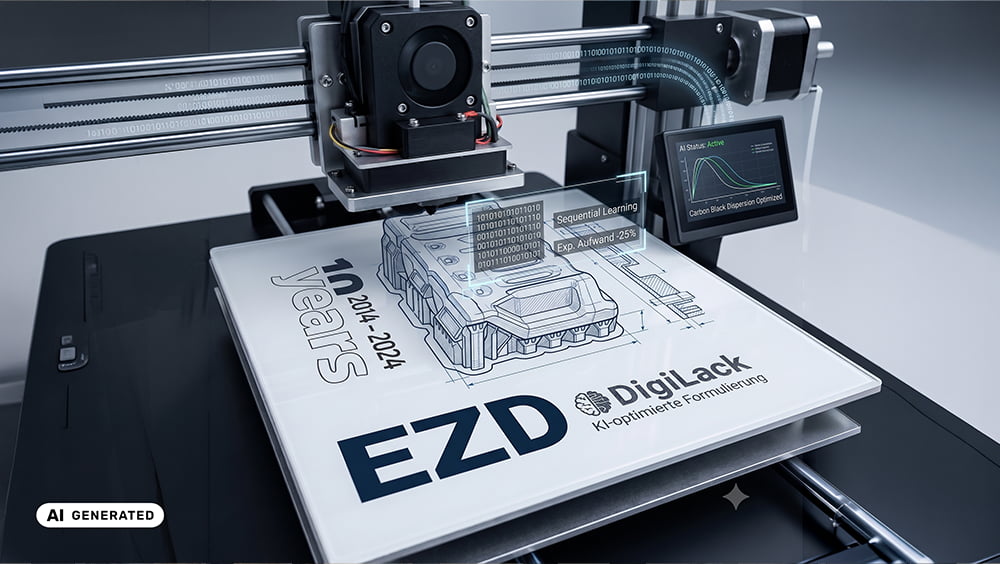
The European Center for Dispersion Technologies (EZD) in Selb has successfully completed the “DigiLack” research project, which ran from August 15, 2023, to December 31, 2025. (Source: EZD/AI-generated)
Data-driven models can replace traditional testing strategies
The development of new coatings and inks has traditionally involved numerous iterative laboratory tests. Extensive test series are often required to achieve defined product properties, which entail significant investments of time, materials, and resources.
“Our goal was to supplement traditional static experimental designs with data-driven models and thereby significantly accelerate the development of coating systems and ink formulations,” explains Andreas Schneider, project manager and senior scientist at the European Center for Dispersion Technologies (EZD). “Digital methods open up new possibilities for reducing the experimental workload, increasing resource efficiency, and at the same time gaining a better understanding of key influencing factors in processes and materials.”
Stabilization Is Crucial for Dispersion
Carbon black, a pigment consisting of soot particles used in numerous coatings and printing inks, served as the model system. Due to its pronounced tendency to agglomerate, carbon black is considered particularly challenging to process and is therefore especially well-suited for generating a meaningful and complex dataset.
The investigations into the grinding and dispersion process confirmed the central role of particle stabilization. Despite mechanical comminution, carbon black particles re-agglomerate after only a short time. The project results show that sustainable stabilization is not possible without suitable dispersing additives. In particular, high-performance additives such as EDAPLAN 918 from Münzing Chemie proved to be a key factor in effectively stabilizing the particles and enabling continuous fine grinding. During the course of the project, both a carbon black-modified, UV-curable, acrylate-based ink and an acrylate-based coating were developed.
AI-Supported Experimental Design Increases Efficiency
A central focus of the project was the application of sequential learning algorithms. This allowed the traditional, static experimental design to be transformed into a dynamic optimization process in which the results of each experiment are immediately incorporated into the planning of further experiments. The influence of specific energy input on product properties such as stability, particle size, and viscosity was specifically investigated as target variables.
The results achieved in the project demonstrate that AI and machine learning methods can make a significant contribution to increasing efficiency in formulation development. In addition to reducing the experimental workload, the data-driven approach improves the reproducibility of development results and supports the targeted implementation of customer-specific requirements. Specific virtual experiments demonstrated that the effort required to determine the target parameters (particle size (<300 nm), viscosity (<100 mPa·s at 25 °C), and stability (<15 µm/min)) could be reduced. Using Bayesian optimization, the optimal target parameters could even be accurately determined with just three to five experiments.
“By combining artificial intelligence (AI) with machine learning methods, development times can be shortened and resources can be deployed in a targeted manner. The number of required laboratory experiments was reduced by approximately 25% to achieve the optimal formulation and process parameters for target parameters such as the desired particle size or viscosity.”
The DigiLack project was carried out from August 15, 2023, to December 31, 2025, at the European Center for Dispersion Technologies (EZD) in Selb by SKZ – KFE gGmbH and funded by the Bavarian State Ministry of Economic Affairs, Regional Development, and Energy.
More information about the EZD