
Dispersion Pilot Plant at the EZD: From Formulation to Scale-up
The European Center for Dispersion Technologies (EZD) in Selb has extensively expanded its dispersion pilot plant and equipped it with state-of-the-art process technology. With this expansion, the EZD is systematically expanding its research and development capabilities. The new infrastructure makes it possible to scale dispersion processes under real-world conditions, produce customer samples, and apply methods for in-process characterization.
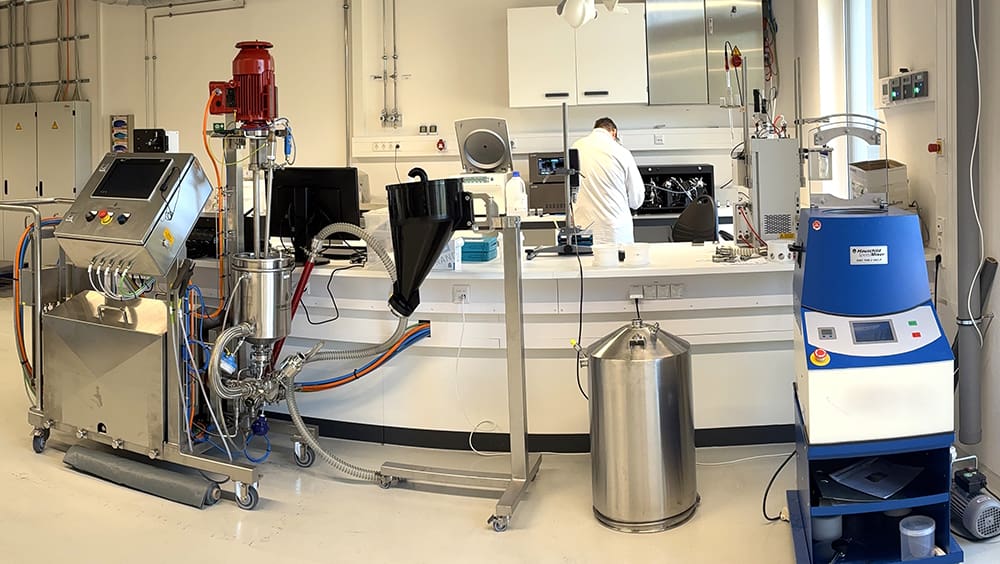
With its expanded dispersion pilot plant in Selb, EZD offers ideal conditions for the development and scaling of dispersion systems. The state-of-the-art plant technology enables practical investigations ranging from the laboratory scale to the production of customer samples, as well as the use of in-process characterization methods. (Photo: EZD)
From Laboratory Development to Industrial Application
Dispersion processes play a central role in the manufacture of numerous products in the plastics, paint, printing ink, adhesive, and coatings industries. At the same time, demands are increasing for product quality, energy efficiency, and the reliable transfer of laboratory results to industrial production.
With the establishment of the Dispersion Pilot Plant, the EZD is creating an infrastructure to scale up processes and formulations from the laboratory to the pilot plant scale.
State-of-the-art equipment for process development
The pilot plant includes a dissolver, an agitator ball mill, a high-pressure homogenizer, and a rotor-stator disperser (inline mixer). This enables the processing of a wide variety of suspensions, emulsions, and resin systems.
The range of services extends from dispersion on a laboratory and pilot plant scale, through the energy-efficient production of dispersions via process optimization, to in-process characterization. The offering is complemented by process comparisons, the testing of scale-up strategies, and customized trial days.
The facility processes water-based, UV-curing, and solvent-based systems. Customer samples can be produced on a scale of 20 to 100 liters. In addition, the premises are available for training sessions and hands-on continuing education programs.
“There is often a critical gap between laboratory development and industrial production. Our dispersion technical center makes it possible to evaluate processes and formulations under realistic conditions and scale them up in a targeted manner. At the same time, the integrated characterization methods create a solid data foundation for optimizing product quality and process efficiency,” says Dr.-Ing. Felipe Wolff-Fabris, site manager of the EZD.
From Formulation to Scale-Up
The development of an electrically conductive, UV-curable ink exemplifies the possibilities offered by the new technical center. First, the fine dispersion of carbon black particles was investigated in the laboratory. The process was then gradually scaled up from the milliliter to the 20-liter scale.
After developing the formulation and testing various dispersion methods on a small-scale and laboratory scale, production was successfully scaled up to a 20-liter batch. Pre-dispersion took place in a vacuum dissolver, after which the particles were finely dispersed in an agitated ball mill.
Efficient Dispersion in a Single Process Step
The production of a highly concentrated calcium carbonate suspension also demonstrates the capabilities of the new pilot plant. Using the inline mixer, powder wetting and dispersion were achieved in a single process step. At the same time, the desired target particle size was achieved in an energy-efficient manner.
Targeted Use of Process Data
Modern methods for in-process characterization complement the pilot plant. Inline rheometers, liquid color measurement systems, and stability analyzers provide information on material properties even during production.
The process data helps ensure product quality, optimize process control, and increase energy efficiency during dispersion. At the same time, in-process characterization methods provide robust and reliable data sets that serve as the basis for the use of AI models for data-driven process optimization and process prediction.
The expanded dispersion pilot plant thus bridges the gap between laboratory development and industrial application. Formulations and processes can be developed, characterized, and scaled under realistic conditions—from the initial formulation to the pilot plant scale.