

Artificial intelligence assesses the quality of butt welds in pipework construction
The quality of welded joints is a crucial factor in the safety and durability of plastic pipework systems. As part of the ‘PipeSafe’ research project, the SKZ Plastics Centre, in collaboration with industry representatives, investigated how modern sensor technology and machine learning methods can be used to predict the quality of welded joints whilst the manufacturing process is still underway.
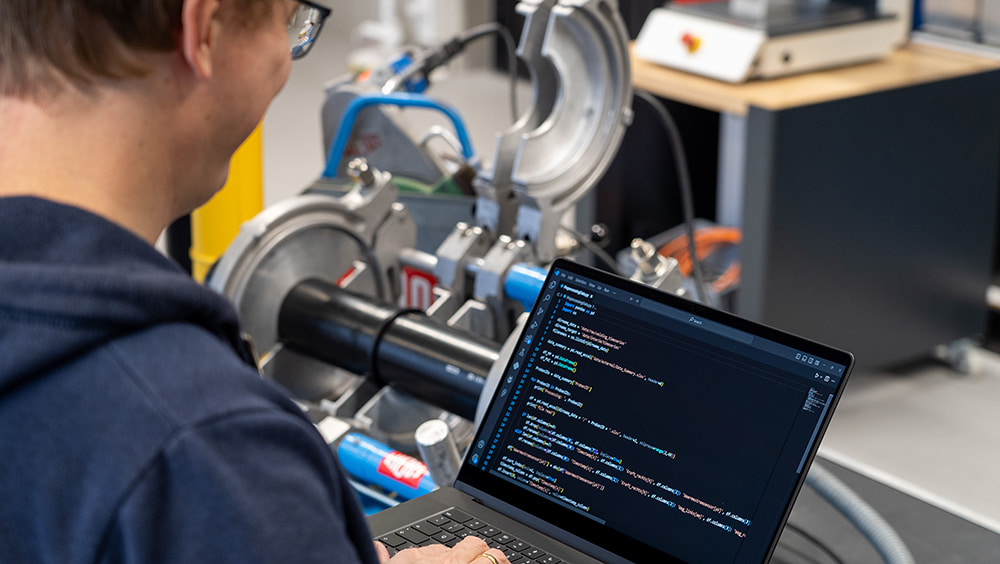
The SKZ’s “PipeSafe” project investigated how artificial intelligence can open up new possibilities for quality assurance in pipeline construction. (Photo: Luca Hoffmannbeck, SKZ)
Research project demonstrates the potential of data-driven methods for the real-time evaluation of welding processes in PE pipework systems
The project was carried out in close consultation with an advisory panel comprising representatives from various sectors. These included manufacturers of pipework systems, welding equipment and measurement technology, as well as testing service providers and distribution network operators. This close collaboration ensured that the research was consistently geared towards the requirements of industrial practice.
The investigations focused on a pilot-plant machine for heating-element butt welding, which was fitted with a heat flux sensor. During each welding operation in the systematic test series using the technical material PE100-RC, the time-dependent curves of the process parameters displacement, force and heat flux were recorded. The quality of the resulting welds was then assessed using technological bending tests, short-term tensile tests and, for individual test specimens, creep tensile tests, and correlated with the recorded process data.
Development of various machine learning models
Based on this data, the project team developed various machine learning models to predict weld seam quality. The models achieved a coefficient of determination of R² = 82.9% for the quantitative assessment of weld quality. For a practical, categorical assessment using a traffic-light system, a coefficient of determination of R² = 89.5% was even achieved. The results show that relevant quality characteristics of welded joints can be predicted with a high degree of reliability even during the joining process.
“With PipeSafe, we were able to demonstrate for the first time that process data such as force, displacement and, in particular, heat flux can be successfully combined with machine learning methods to predict the quality of welded joints. The results achieved represent an important step towards smarter and safer welding processes in pipework construction,” explains Mingo Kübert, a scientist in the Digitalisation Research Group at SKZ.
At the same time, the project also highlighted the challenges involved in developing data-driven quality models. Significantly larger datasets would have been required to further improve the accuracy of the models. Furthermore, it was not possible to carry out extensive long-term strength tests as part of the project, as these involve considerable time and financial expenditure. In the opinion of the advisory board, it is precisely these long-term investigations that would be of particular importance for many industrial applications and could provide additional insights in the future.
Groundbreaking results
Despite these limitations, the project team regards the results as groundbreaking for the further digitalisation of welding processes. The combination of modern sensor technology, process data analysis and artificial intelligence opens up new possibilities for quality assurance in pipework construction. There is therefore considerable interest in continuing the work in an in-depth follow-up project in collaboration with machine manufacturers and other industrial partners.
Further information on the Digitalisation Research Group