

Approaches, Knowledge, and Tools for Practical Application: Company-Specific Transformation Pathways to a Circular Economy
How can we make the transition from linear to circular value creation? This was the question addressed at this year’s KARE Network Session on September 29, 2026, at the Würzburg-Schweinfurt University of Applied Sciences. Companies, research institutions, and network partners came together to share experiences, learn from one another, and jointly develop solutions for the circular economy. The KARE Competence Center supports companies in the plastics industry in this endeavor through training, knowledge transfer, networking, and practical tools for transformation.
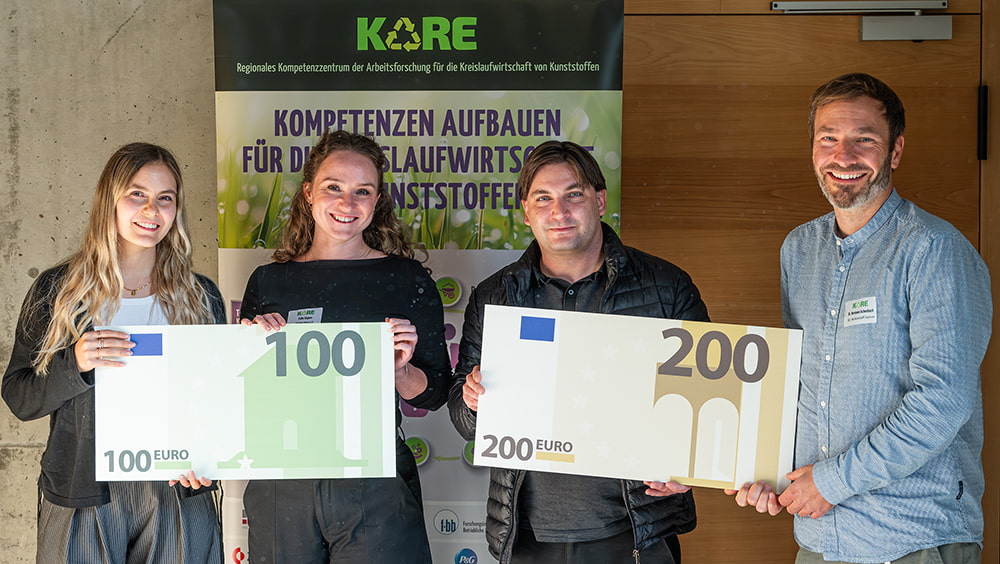
Honoring the winners of the KARE Ideas Competition (from left): Lisanne Klink (Röchling Medical), Erika Unjaev (Röchling Medical), and Robert Strecker (Röchling Medical, first-place winner) with Dr. Hermann Achenbach (Head of Sustainability and Circular Economy, SKZ). (Photo: Johannes Platzer, THWS)
KARE Network Session Highlights Successful Pathways to the Circular Economy
The event made it clear that there is no single, “correct” path to the circular economy. Rather, companies are pursuing different approaches to conserve resources, close material loops, and establish sustainable business models.
Real-world examples from companies illustrated the wide range of possible transformation approaches. For instance, REHAU Window Solutions used window profiles as an example to demonstrate how digital product passports can create transparency across the entire life cycle and thereby support future material cycles. Plastship highlighted the importance of standardized material and testing data to simplify the use of recycled materials in practice.
Röchling Medical presented the development of a trocar in which sustainability considerations were integrated into the product development process at an early stage. The goal was to reduce resource consumption and environmental impacts throughout the entire product life cycle. Maincor used the example of recycling composite pipes to demonstrate how even unconventional collaborations can open up new avenues for a functioning circular economy.
“The examples presented have impressively demonstrated that the circular economy is no longer a theoretical vision. Many companies are already successfully implementing measures today. The key is not to follow a predetermined master plan, but to find the path that suits one’s own company and to consistently develop it further,” says Jonathan Lambers, head of the “Transformation of the Plastics Industry” research group at SKZ.
Transformation Rarely Follows a Straight Path
The presentations also made it clear that successful transformation rarely follows a straight path. Setbacks, adjustments, and new attempts are all part of the process. At the same time, the real-world examples showed that persistence pays off and that many solutions are already working today. The event thus encouraged participants to pursue their own ideas and try out new approaches.
Knowledge Transfer and Networking as Success Factors
In addition to the technical presentations, interactive workshops were an important part of the event. Here, companies, researchers, and other stakeholders discussed specific challenges and practical solutions. The intensive exchange once again highlighted the high value of knowledge transfer and networking for the successful implementation of the circular economy.
The partner project KREIS added an occupational psychology perspective to the discussion and made it clear that successful transformation requires not only technologies and skills, but also employee acceptance, participation, and a willingness to change.
Practical Tools for Companies
In addition, participants had the opportunity to explore the Circular Economy Gap Detector (CEGD) right on site. This self-assessment tool helps companies evaluate their current stage of transformation, identify potential areas for improvement, and derive initial recommendations for action.
Also presented was the new Zero-Pellet-Loss Web-Based Training (WBT), which supports plastics processors and recyclers in building knowledge and practical skills to prevent pellet loss.
KARE Ideas Competition Honors Innovative Approaches
A highlight at the conclusion of the event was the awards ceremony for the KARE Ideas Competition. This competition encourages employees to submit their own ideas for greater resource efficiency and the circular economy.
First place went to Röchling Medical for standardized checklists in sampling processes designed to ensure knowledge retention and resource efficiency. Also honored were the idea “Waste Prevention Through Awareness” from Röchling Medical and “Recycling of Test Parts Instead of Disposal in Residual Waste” from the Wirthwein Group.
The circular economy begins with the first step
The KARE Network Session made it clear that the transformation to a circular economy is already in full swing. Technology, expertise, and collaboration are key factors for success. Above all, however, the numerous practical examples showed that companies do not have to wait for the perfect solution to take their first steps.
Or, as Prof. Dr. Müller-Steinfahrt from THWS aptly put it at the conclusion of the event: “Just do it.”
Further information on KARE
Available for free:
Circular Economy Gap Detector
Zero-Pellet-Loss WBT