

Abrasion Drum at SKZ: Expanded Testing Capabilities for a Wide Range of Material Applications
The SKZ Plastics Center in Würzburg is expanding its range of services in the field of materials testing. With the abrasion drum, which is already being used successfully for tests in accordance with DIN EN ISO 22182, the testing laboratory will in the future be able to address numerous additional applications beyond its current scope of use.
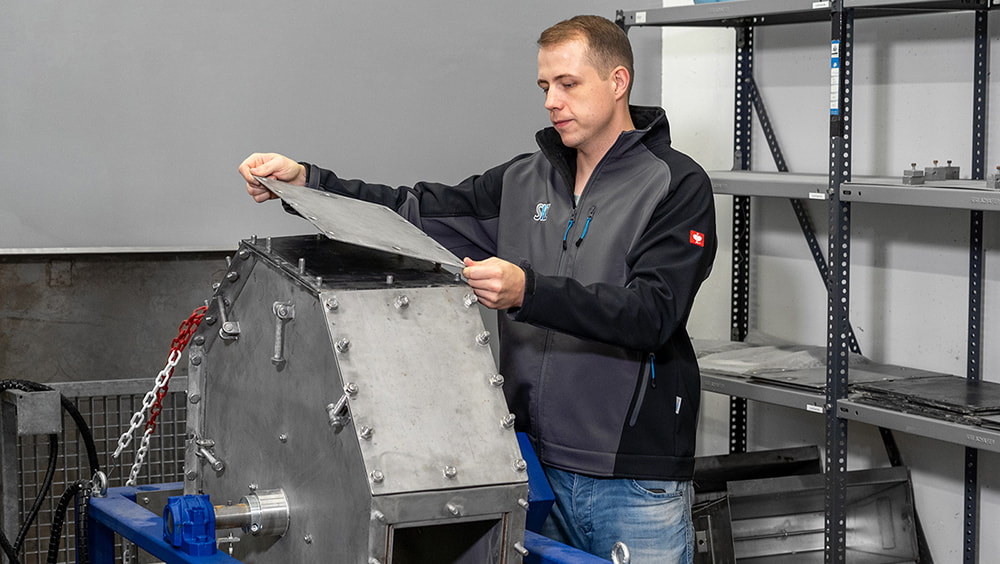
Set to be used in numerous industries in the future: the abrasion drum in the SKZ testing laboratory. (Photo: Luca Hoffmannbeck, SKZ)
New testing technology opens up additional applications in research and industry
The abrasion drum makes it possible to analyze the abrasion behavior and mechanical durability of flexible materials under realistic conditions. Inside the rotating drum, water and basalt grit act on the test specimens. A defined number of revolutions generates a reproducible mechanical stress, allowing material changes to be reliably evaluated. The subsequent analysis is performed, for example, by comparing mechanical parameters or functional properties before and after the test.
While the testing method was originally used primarily in the field of geotextiles, the testing technology employed opens up numerous other applications. Due to the relatively gentle yet realistic stress conditions, the abrasion drum is particularly suitable for flexible and textile materials whose long-term durability against friction and mechanical stress needs to be evaluated.
Wide range of applications across various industries
With its existing testing infrastructure, the SKZ will be able to support a wide range of additional industrial sectors in the future. These include, among others, technical textiles such as protective clothing, tarps, tents, or filter fabrics, as well as applications in packaging and logistics, such as flexible packaging, films, composite materials, or big bags. In addition, sports and outdoor products—for example, materials for backpacks, tents, or boat covers—as well as textile and flexible materials used in medical technology, such as bandages or compression products, can be tested.
The automotive industry can also benefit, for example in the area of interior materials or trunk linings. In filtration and membrane technology, filter fabrics and membranes can also be tested under abrasive conditions. For marine applications, the abrasion drum is particularly suitable for testing nets, ropes, and protective materials for maritime use.
Fiber-reinforced composites—particularly fabric reinforcements in plastic matrix systems—can also be reliably tested. The range of applications is rounded out by use in architecture and construction, such as for facade textiles, sun sails, or waterproofing membranes.
Flexible testing method for research and industry
A particular advantage of the abrasion drum lies in its adaptability: test parameters such as test duration, load intensity, or motion cycles can be adjusted to suit different materials and operating conditions. This makes the testing device suitable for both industrial quality control and research and development projects.