
A New Agent-Based System for Industrial Computed Tomography
Microvista GmbH and the SKZ Plastics Center are collaborating on the “ICQ” research project to develop a novel assistance system for industrial computed tomography (CT). For the first time, the platform combines agent-based AI systems, multimodal search, and specialized analysis tools for non-destructive testing. The goal is to evaluate two- and three-dimensional data more easily, quickly, and reproducibly.
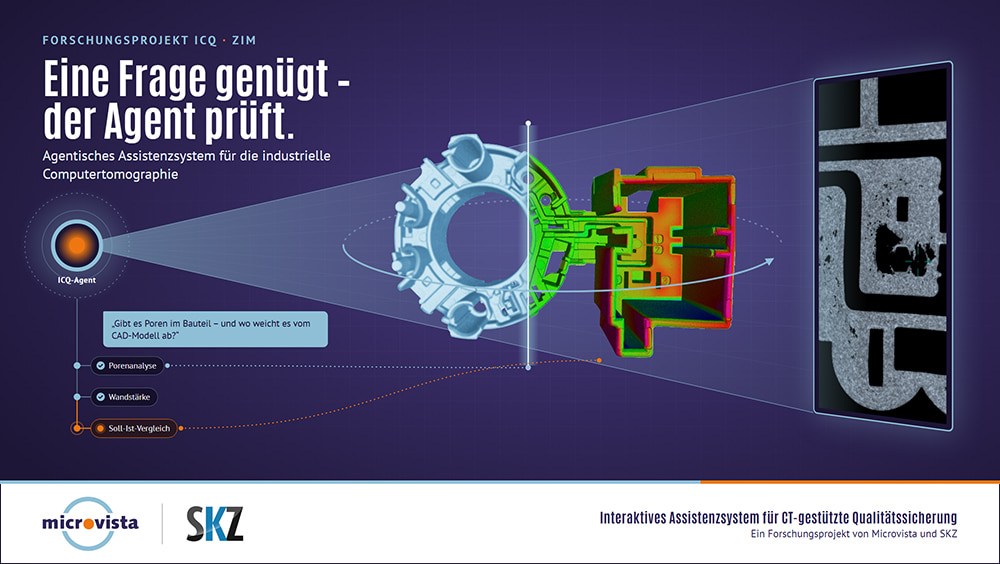
As part of the “ICQ” research project, Microvista and SKZ are developing a novel assistance system for industrial computed tomography (CT). (Photo: SKZ)
An interactive assistance system for CT analysis that automates inspection processes on a case-by-case basis, reduces the workload on specialists, and simplifies access to complex inspection procedures
Industrial inspections of plastic components are time-consuming, labor-intensive, and heavily dependent on the expertise of individual specialists. This is particularly true for CT inspections. The “ICQ” research project therefore pursues three central goals: the automation of complex CT evaluations, reducing the workload on specialists through AI-supported assistance, and the creation of a user-friendly platform that enables even less experienced users to perform demanding inspection tasks. The aim is to make industrial quality assurance more efficient, scalable, and future-proof.
Quality assurance gets a boost
Industrial CT is one of the most important non-destructive testing methods. It provides a detailed view of the interior of components and is used in the plastics, automotive, aerospace, and medical technology industries, among others. However, analyzing the generated data has thus far required a high degree of expertise and involves significant costs and time.
To address these challenges, Microvista GmbH from Blankenburg/Harz and SKZ from Würzburg have launched the research project “Interactive Assistance System for CT-Based Quality Assurance (ICQ).” The project is being implemented as part of the Central Innovation Program for SMEs (ZIM) with funding from the BMWE.
Development of a Cloud-Based Platform
The focus is on developing a cloud-based platform that automatically processes CT data and supports users via a natural language interface. Instead of manually executing complex software functions, users will in the future be able to formulate questions or inspection tasks directly in a chat window. The system then independently plans the necessary analysis steps, calls up suitable tools, and provides the results as reports, tables, visualizations, or text responses.
Planned features include automatic plausibility checks of CT scans, the detection and analysis of pores and other material defects, the measurement of wall thicknesses, the comparison of CT data against CAD models, and a semantic search function that makes it possible to locate similar defect patterns or components across large datasets.
Planning Assistant Handles the Analysis
A particular innovation is the agent-based AI system. Here, a planning assistant analyzes the user’s request and determines which tools are needed. An execution agent then coordinates the individual steps and returns the results. This is intended to enable even complex inspection tasks to be processed automatically, in a traceable and reproducible manner.
While Microvista GmbH contributes its expertise in the areas of industrial CT, data management, and AI-supported defect analysis, the SKZ is primarily developing the agent-based assistance architecture, semantic search, and the automated comparison of actual and theoretical states between real components and their digital models.
The project, scheduled to last 30 months, is expected to ultimately produce a validated prototype that achieves at least a 30 percent increase in efficiency compared to today’s manual processes, as well as higher evaluation accuracy. “In the long term, the concept opens up new possibilities for scalable, AI-supported quality assurance and could significantly simplify the use of industrial computed tomography—particularly for small and medium-sized enterprises—thereby making it more cost-effective,” said Tim Dees, project manager and digitalisation scientist at SKZ.
Further information on the Digitalisation Research Group
The ICQ project (FK: KK6028313GR5) is funded by the Alliance for Industry and Research (AIF) on behalf of the Federal Ministry for Economic Affairs and Energy (BMWE).