

New halogen-free flame-retardant resins for additive manufacturing
The SKZ Plastics Center and the German Textile Research Center North-West (DTNW) have launched the IGF-funded “FSM-Resine” project. The focus is on developing halogen-free, acrylate-based, photoreactive flame-retardant systems for SLA and DLP resins, which enable flame-retardant and mechanically high-performance materials for additive manufacturing.
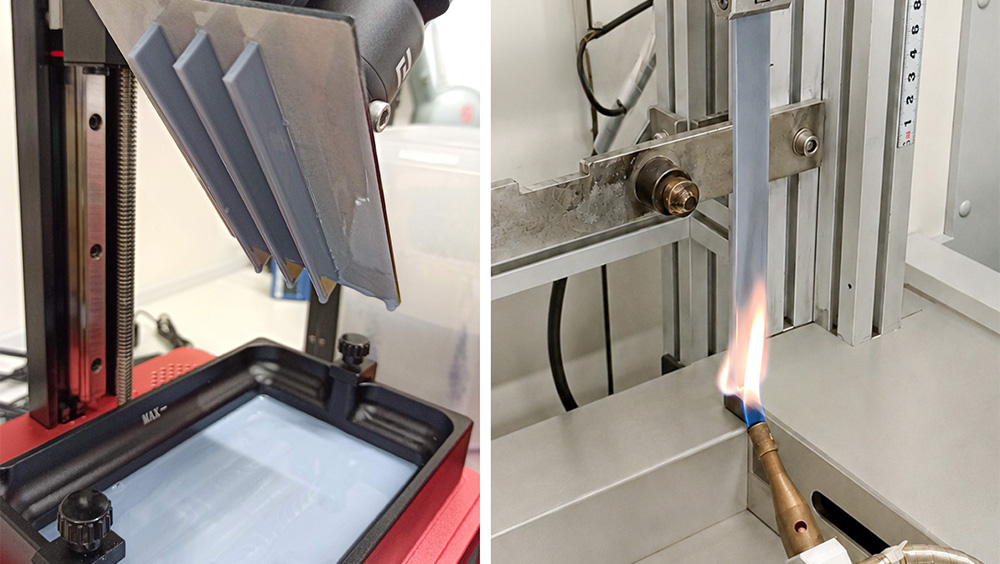
Resin-based 3D printer used to produce three UL94 test specimens (left) and conducting a UL94 flame resistance test (right). (Photo: Wael Ali, DTNW)
IGF project develops high-performance, flame-retardant materials for SLA and DLP processes
In recent years, additive manufacturing has emerged as a key technology in industrial production. Particularly in the field of resin-based processes such as stereolithography (SLA) and digital light processing (DLP), it offers exceptionally high resolution, design freedom, and speed. Nevertheless, the industry faces a major hurdle: There is a lack of suitable, flame-retardant photopolymers that meet the increasing demands in electronics and electrical engineering, mobility, rail, and building technology.
The flame-retardant resins currently available on the market are often limited in their application, for example due to equipment-specific requirements, insufficient mechanical properties, or unfavorable processing characteristics such as high viscosity.
Permanent and low-migration flame retardancy
This is where the joint research project “FSM Resins” by SKZ and DTNW comes in. The goal is to develop photoreactive, acrylate-based flame retardants (FSM) that are chemically incorporated into the photopolymer. This is intended to achieve permanent and low-migration flame retardancy. At the same time, the project aims to achieve low viscosities, good processability, and high mechanical performance of the materials—compatible with standard SLA and DLP systems.
SMEs as the primary target group
The project is being carried out as part of the Industrial Collaborative Research (IGF) program and is specifically aimed at small and medium-sized enterprises (SMEs). These companies benefit from pre-competitive access to research results, practical material development, and new market opportunities through flame-retardant components produced via resin-based additive manufacturing.
Interested companies are invited to participate free of charge in the project committee, thereby actively contributing industrial requirements and their own use cases to the project work and benefiting from the results at an early stage.
Dr. Thomas Mayer-Gall, research group leader at DTNW, emphasizes the importance of this research project: “The covalent incorporation of flame-retardant properties into photopolymer-based resins opens up new possibilities for achieving sustainable and high-performance flame retardancy in additive manufacturing.
Benjamin Escudero, research associate for additive manufacturing at SKZ, adds: “With the FSM Resins project, we are developing flame-retardant SLA and DLP resins that can be processed without equipment-specific restrictions, provide high flame retardancy, and are economically viable, particularly for small and medium-sized enterprises.”
More information on additive manufacturing