

SKZ Develops Testing Concept for Condition Assessment of PE Gas Pipes Using Small Samples
The Kunststoff‑Zentrum SKZ, in collaboration with partners from the gas industry, has developed a new testing and assessment concept for evaluating the condition of buried polyethylene (PE) gas pipes. The concept was developed as part of a research project funded by the German Technical and Scientific Association for Gas and Water (DVGW) and is based on investigations using small material samples.
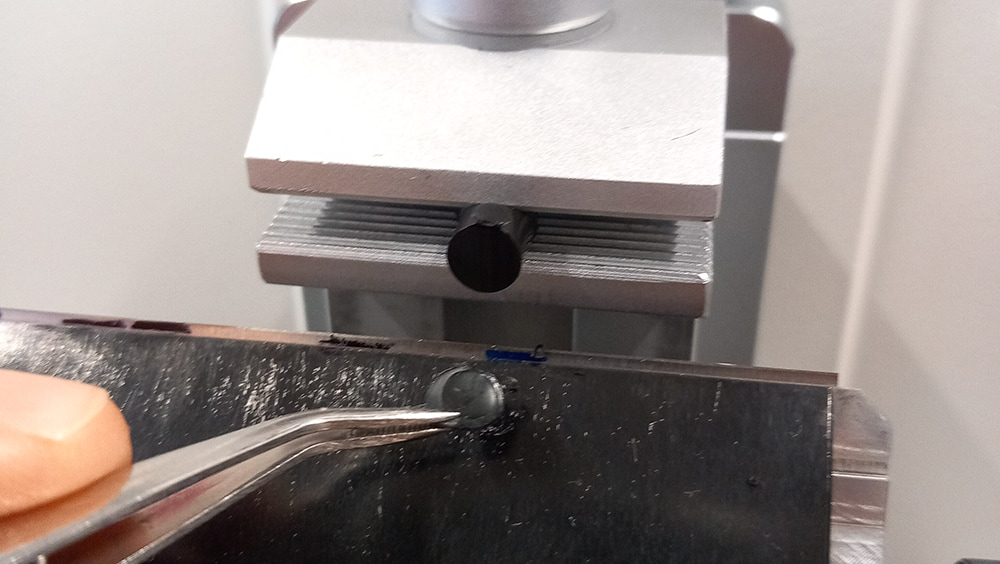
Sample preparation for spatially resolved OIT measurements using a rotary microtome. (Photo: Daniel Hautsch, SKZ)
Minimally invasive approach enables reliable analysis directly from operating gas networks
The new approach allows the condition of PE pipes to be assessed using small samples taken directly from operating networks. This methodology enables minimally invasive condition assessment without the need to remove entire pipe sections and provides reliable data for decision-making regarding continued operation, monitoring, and maintenance of gas infrastructure.
Growing demand due to energy transition and ageing networks
Against the backdrop of the energy transition and the increasing use of hydrogen‑containing gases, the reliable assessment of existing gas distribution networks is becoming ever more important. Particularly in older networks, material documentation is often incomplete, while established assessment methods typically require the removal of entire pipe sections, resulting in considerable effort and cost.
Development of suitable sampling and testing methods
The project therefore focused on developing appropriate methods for extracting and preparing small samples, as well as transferring established material testing techniques to these specimen sizes. Particular attention was given to failure mechanisms relevant to long‑term operation, including slow crack growth and thermo‑oxidative degradation.
Testing methods included the strain hardening test, tensile testing, and spatially resolved measurements of oxidation induction time across the pipe wall thickness.
Validation using reference and field-extracted pipes
The methodology was applied to both reference pipes and pipe materials taken from real network operations, covering different PE types, dimensions, and service lifetimes. Based on the findings, a modular testing program was developed, allowing different levels of analysis depending on the specific requirements and available sample size.
“Using this approach, condition-relevant information can be obtained from very small samples that are either already available from network operation or can be taken with minimal effort,” explains Dr. Mirko Wenzel, Expert Scientist at SKZ. “This provides network operators with a practical tool that complements existing testing concepts and significantly reduces sampling effort.”
More information on component properties