
“Skills4Circle” Research Project Strengthens Skills for the Circular Economy
Through “Skills4Circle,” a project consortium is strengthening training for a sustainable circular economy. The focus is on practical, adaptive learning formats that help companies in the chemical and plastics industries efficiently develop future-oriented skills among their employees in a way that meets their specific needs.
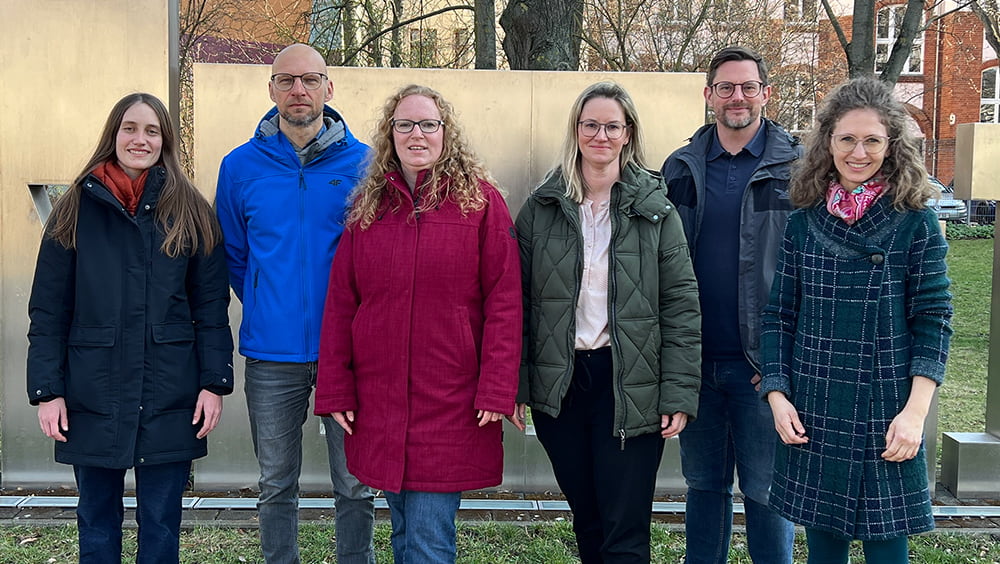
Kick-off meeting for the “Skills4Circle” project team. (Photo: SKZ)
Project Provides Targeted, Practical Support to Companies in Training Their Employees
The project “Skills4Circle – Skills for a Circular Economy,” the SKZ Plastics Center, Provadis Partner für Bildung und Beratung GmbH, and the Chair of Engineering Education and Didactics of Technical Education at Otto von Guericke University Magdeburg are pooling their expertise in a joint educational initiative.
The transition to a circular economy is becoming increasingly important for industrial companies. Increasing regulatory requirements, dwindling resources, and growing expectations for sustainable production and business models demand a fundamental shift in thinking along the entire value chain. For companies in the chemical and plastics industries, this means aligning materials, processes, and products more closely with circular principles and adapting existing structures.
At the same time, many companies still lack the necessary expertise to systematically implement these changes. This is exactly where “Skills4Circle” comes in: The goal is to provide companies with targeted support in developing and implementing sustainability-related training measures and to equip employees to meet the requirements of a circular economy.
Employees who actively implement this change in their day-to-day work are a central key element in the transformation. The project therefore develops adaptive learning programs that flexibly adjust to learners’ individual knowledge levels and needs. The content is based on real-world operational requirements and is developed, tested, and continuously refined in collaboration with companies in the chemical and plastics industries.
Companies should be empowered to actively shape the transformation
“The circular economy requires new skills in all areas of the company—from material development and process efficiency to sustainable business models,” explains Malena Müller, project manager for Skills4Circle at SKZ. “With Skills4Circle, we are creating practical learning opportunities that support companies in their transformation and empower employees to actively contribute to resource conservation.”
Close collaboration with companies is a central component of the project: They contribute their perspectives to the development process, test the learning programs in practice, and support their further development. This results in training formats that can be specifically integrated into operational workflows and impart knowledge that is immediately applicable.
“For companies, it is crucial that training programs specifically address their actual needs while also being flexible in their application,” emphasizes Marny Schröder, project manager for “Skills4Circle” at Provadis. “The learning formats developed in the project combine personalization with practical application, thereby facilitating the transfer of knowledge into everyday work.”
In addition, industry associations, social partners, and other key influencers are being involved in the project. They help tailor the developed training approaches to industry-specific requirements and enable their dissemination beyond individual companies. In this way, the groundwork for broad-based implementation is laid even during the project’s duration, ensuring the results’ scalability.
In addition to practical implementation, a solid didactic foundation also plays a central role. Scientific expertise in the field of adaptive learning systems and competency development ensures that the learning offerings are not only practical but also designed to be effective. “Adaptive learning systems make it possible to specifically address different learning prerequisites and design learning processes more efficiently,” explains Dr. Stefan Brämer of the University of Magdeburg.
Innovative Training Throughout the Development and Production Process within the Company
In addition to the digital learning modules, the project is developing a comprehensive training concept as well as a guide for adaptive online training in the circular economy. The training modules are modular in structure, can be flexibly combined, and can be deployed across various company departments. The participating companies are closely involved in the development process, ensuring that the learning offerings can be continuously adapted to operational requirements. Throughout the project, the training courses are available to participating companies free of charge and offer the opportunity to test new training approaches in a practical setting.
A Strong Consortium for a Sustainable Future
The project brings together expertise from education, research, and industrial practice:
The SKZ contributes its expertise in plastics technology and the circular economy; Provadis ensures practical implementation in corporate continuing education; and Otto von Guericke University Magdeburg complements the consortium with its scientific expertise in engineering education. The goal is to ensure that the content is not only technically sound but also pedagogically effective and flexible enough for use in everyday work. This systematically supports the transfer of project results to companies. Together with companies, industry associations, and social partners, a holistic approach is being developed that combines technical, pedagogical, and practical requirements and supports the sustainable use of the project results.
Companies Sought for “Skills4Circle”
Practice partners are involved in the project. We are currently seeking additional companies that would like to test the learning modules and contribute to their further development through their feedback. Companies in the chemical and plastics industries, in particular, are invited to get actively involved. They will benefit from early access to innovative training approaches and can help shape the content to meet their specific needs.
Funding Information
The “Skills4Circle – Skills for a Circular Economy” project is funded as part of the “Sustainable Careers – Future-Oriented Training” program by the Federal Ministry of Education, Family, Senior Citizens, Women, and Youth and the European Union through the European Social Fund Plus (ESF Plus). The project receives technical support from the Federal Institute for Vocational Education and Training (BIBB) and is administratively implemented by Knappschaft-Bahn-See (KBS).