

Goodbye, Dust: New Research Project Aims to Improve Quality in Plastics Processing
SK Industriemodell GmbH, Odenwälder Filtersysteme GmbH, IANUS Simulation GmbH, and the SKZ Plastics Center are collaborating on a newly launched research project to develop a simulation tool for melts containing solid foreign particles. The goal is to digitally optimize filters when using recycled materials in plastics processing. This is intended to reduce both filter changes and maintenance intervals while significantly increasing efficiency—particularly in injection molding.
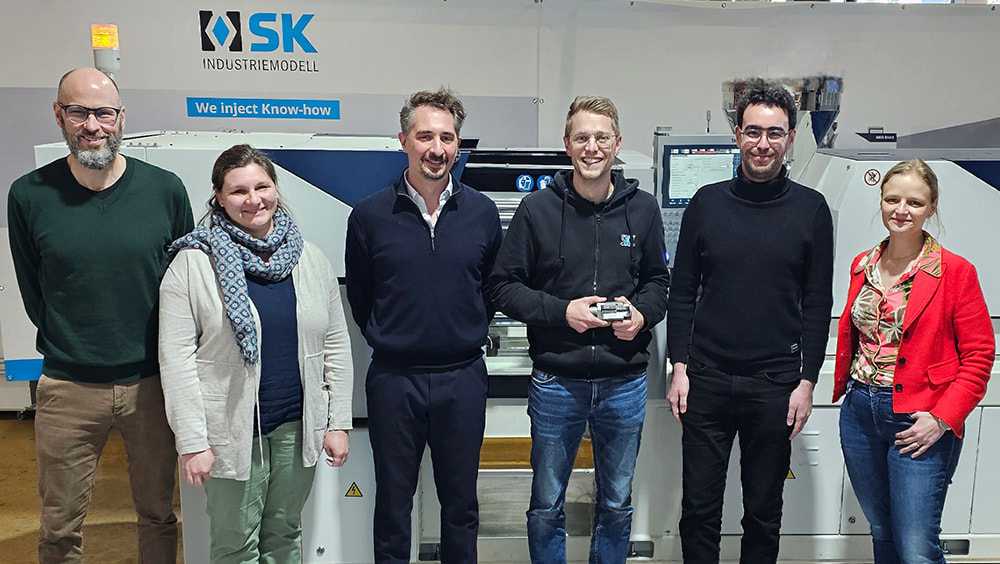
Kick-off meeting of the project consortium at SK Industriemodell (from left): Michael Dörsam (Managing Director, Odenwälder Filtersysteme GmbH), Christina Hoffmann (Scientist, Compounding and Extrusion, SKZ), Tom Cvjetkovic (cvt engineering), Tobias Göbel (Scientist, Compounding and Extrusion, SKZ), Ali Chalgham (Project Manager, IANUS Simulation GmbH) and Lena Liebenstund (Head of Quality Management and Project Management, SK Industriemodell GmbH). (Photo: SK Industriemodell GmbH)
Precise foreign particle filtration ensures higher recycled material purity
Filter inserts can be installed in injection molding machines to clean recycled melt. These temporarily trap solids from the melt. However, to enable widespread use of these filter inserts, their applicability for SMEs must be improved. Digital technologies such as multiphase simulations offer solutions to overcome these challenges and enable SMEs to design resource-efficient, high-quality, customized filter nozzles. Advances in the simulation of plastic melts make it possible to model even fine elements such as filters containing solids.
Simulation Tool for Two-Phase Simulation
In this newly launched research project, the companies SK Industriemodell GmbH, Odenwälder Filtersysteme GmbH, IANUS Simulation GmbH, and SKZ are collaborating with the engineering firm cvt engineering to develop a simulation tool for two-phase simulation (melt & solid) aimed at digital filter optimization and equipment design when using recycled materials (containing foreign substances) in injection molding.
“The simulation tool is fed with experimental data from injection molding trials. Due to its broad applicability, it is intended to improve the usability of recycled materials in injection molding. This is an important goal for the sustainability of plastics,” explains Christina Hoffmann, a scientist at SKZ. The project aims to expand technical expertise so that well-founded decisions can be made regarding equipment design in terms of filter size and replacement intervals. This will help remove barriers to the use of recycled materials by SMEs through the filter technology and simulation developed in this research.
Fluctuating Properties of Recycled Materials
The use of recycled materials in plastics processing is steadily increasing. Reasons for this trend include not only growing public environmental awareness but also political demands and regulations, as well as rising disposal costs. Despite the wide range of available sorting techniques, filtration, and separation systems, recycled materials sometimes exhibit fluctuating properties compared to virgin material.
This is primarily due to foreign particles contained in the plastic as contaminants. These contaminants pose a problem for plastics processors, as they increase the frequency of cleaning intervals and can lead to quality fluctuations in the produced components.
This project, with grant number 033RK126D, is funded by the Federal Ministry of Research, Technology, and Space (BMFTR) from January 1, 2026, through December 31, 2027.